Skip to Content Skip to Search Go to Top Navigation Go to Side Menu


"research" Category


Golden Joinery – a fashion label with focus on the genuine, personal meeting


Friday, May 24, 2013


Quick fashion, one trend after another. Passion for fashion becomes synonymous with renewing yourself and being up to date.

In today’s reality where we consume more than we need, where we meet and communicate through one screen or another and where machines can basically do everything, there are some necessities for experiencing the genuine and personal that cannot be simulated by any kind of machines.

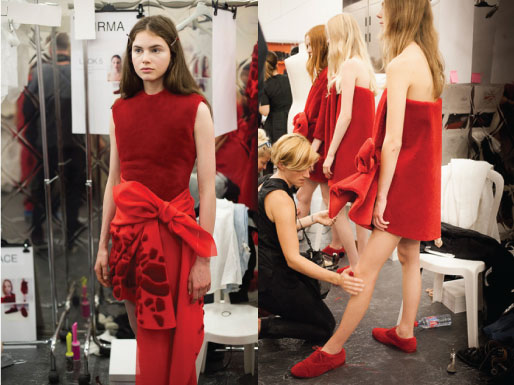
Saskia van Drimmelen has been a fashion designer for two decades, graduating from the fashion Department of Arnhem Academy of Arts. For eight years she had her own brand and followed the fashion markets system with presenting two collections per year. Her collections were selling at leading boutiques such as Colette (Paris), Brown (London) and Van Ravenstein (Amsterdam). Her work was shown and bought by museums all over the world and Adidas asked her to design a sneaker. But along the way her interest and approach changed direction. Together with Margreet Sweerts, theater director, she begun to investigate ways to create more personal, unique, “slow” clothes and in 2007 they started Painted Series – a story in garment. A label with an embrace of handmade as opposed to mass production. They travelled to places where almost forgotten knowledge of craftwork still was practiced. To Bulgaria where women knew the tradition of making needlepoint and from the Assiniboine tribe in Northern America they learned about beadery. Collaborations started with different people involved to make the slowly ever-growing collection, like a bands repertoire. The collection is not bound to a season or trends.

The starting point for Saskia and Margreet were beautiful antique family garments from Bulgaria that had been inherited through generations and added to in each led. The pieces carried a story and a soul that inspired the duo to create garments with the same idea of letting designers and artisans traditional techniques contribute. As a result the collaboration creates a personal, unique, delicate piece of clothes that carries a story, tradition and a close relationship to its creators.

With the quote from Leonard Cohen “There is a crack in everything, that’s how the light gets in” the Painted present their latest project Golden Joinery. Often when we repair broken things we do it with intention to hide it and make it as if new. An alternative “broken is better than new” aesthetic – that it actually can add value and the symbolic aspects – fascinates the fashion collective. With the passion for imperfect love they invite for a workshop where clothes that are broken or stained can be repaired with a golden scar. The inspiration came from the Japanese tradition of repairing broken ceramics with golden paint, a technique called Kintsugi. The invitation is to bring a piece of clothes that you hold dearly and that is defect, to a workshop and repair it with the same idea as Kintsugi, with golden thread or patches of golden textile. The clothes breath new life by sharing the joy of making with the traditional techniques and an important aspect is the experience and the interaction. The participants are contributing to a new brand that slowly will arise.


In Painted’s studio in the west of Amsterdam, four women came together with the originators of Golden Joinery and their brought broken beloved clothes wear. For a couple of hours we took a break from our duties and sat down to repair and to meet. I brought for myself a “new” but long looked for, perfectly worn out second hand leather jacket. The seams on the inside were completely trashed, the lining material was sticking out every time I put it on. I healed it with golden thread and the jacket slowly held together again. The golden thread gives me the feeling that it will hold forever. Knowing that, I will walk around with the golden thread on the inside, towards my body giving the feeling of a secret. If the jacket opens you might glimpse some shimmer and if you ever heard about Golden Joinery you will know the deal.


The people that come to the workshop are now a part of a new slowly arising brand. The logo, a small golden ellipse, that Saskia stitched on the left inside of my jacket is shining like a beetle and makes me a part of the ever-growing Golden Joinery. The event and the knowledge that more people have been joining the same thing and you might spot the signs on the street makes it a bit special. My relationship to this jacket is now closer, like a friend that I supported. I haven’t known the friend for a long time but some you get close to quicker and some events can enhance this intimacy. This definitely did.

Apart from Amsterdam, Painted will give the workshop Golden Joinery to enrich garments in Masstricht, New York, Wrightwood, Ahmedabad, Eindhoven, Paris and Mallorca.

For more info about the fashion collective go to http://paintedseries.com/


Culture mixing and the living-room memories I’ve never had


Friday, March 8, 2013

In my quest to choose an object to research out of the current display of design at the Stedelijk Musem I initially thought I would go against my instincts. I thought small, delicate, rational. I even went as far as to write a full research on “small, delicate, rational” but after I was done I couldn’t go to sleep. Needless to say, my roots got the best of me and I ended up being hunted down by the work of Philip Eglin. To give a little background Eglin is an alumni of the Royal College of Art in London and he is specialized in ceramics.

The work in question is entitled “Virgin and dead Christ” and it was made in 1998. The decade it was made in is so well embedded in it in fact that it has on one side Hugh Grant’s ’95 mugshot. Instinctually I wanted to know a bit more about the motivation for such a detail, and Mr. Eglin obliged me with a reply (in the age of rapid fire communication, artists apparently are kind enough to answer the curious):


Something as dated as this reference could now sound obsolete (in fact, it is assumed as dated), but in my view it’s delightfully reminiscent of the time when I was a kid and also of Romanian style of ceramics that I grew up with – not in the traditional sense, but in the purely kitsch one.

Easy to say that ceramics was never considered art in the country I come from. It’s purpose was either utilitarian (dishes, cups, etc), traditional (folkloric patterns) or of display on a smaller scale (think grandma’s living room, on a shelf).

My most prominent memory of ceramics is in fact the last one of the above since throughout communist times (until 1989) in Eastern Europe and even well after (old habits die hard) it was a custom to gift and later to show off in your vitrine figurines which made no connection to the sorroundings of your living room and which were hidden behind glass for purely functional reasons (it saves on a lot of dusting hours). I suspect this was done because of the need to be sorrounded by beauty, but given the lack of education on the subject, never a true understanding of how to handle and consume said beauty.

The most common subjects which found their way into Romanian living-rooms were porcelains (named “bibelouri”, from the French “bibelot” or English “trinket” – which stands for ornament) of: random French couples dressed a la 17th century, random curved ladies in provocative poses, ballerinas large and small, peasants male and female, mythological figures, horses, peeing little boys, Christ and Madonna figures, dogs, chicken, weasels, bunnies and other furries.

The list was peculiar but standard. The objects, always poorly made, did not have any other redeeming qualities either than a striving for beauty and having been made of materials more delicate than plastic.

These tiny sculptures were never displayed as individual pieces, but crammed together. So, you would always see a bizarre Noah’s ark of larger than life dogs next to ballerinas and in a 17th century French setting in a 20th century Eastern European living room.

Seeing Philip Eglin’s work in the Stedelijk museum only later brough on the realization that I was, in front of “Virgin and Dead Christ”, catapulted back into a Romanian living room. The work screams contemporary through it’s eclectic mix of features on the two characters and patterns on their surface, but it also comes to me as a comentary against cleanliness and the rationality of Dutch design.

There is no reason, everything seems to have been pushed together against it’s will. The theme speaks of centuries of reinterpretation, during which the Madonna has been turned on all of it’s sides, so much so that now it’s impossible to have just one view of what the scene should look like. The subject has been done and done to death. Maybe that is why if it is to be done again it can only be done with a sly humour and a stamp of Hugh Grant’s face on it’s side. No longer can we look at it in reverence. The relation that we have with the image goes beyond “no judgement”, it’s also somehow pop culture in itself.

There are inspirations in Eglin’s work which are easily traceable” Northern Gothic religious woodcarvings, Chinese porcelain, English ceramics, contemporary packaging, popular culture. There is also a lot of humor as his later work (porcelains of the Pope, footbal teams etc) would go on to suggest.

Choosing Eglin has been for me an exercise in respecting my roots and disregarding the fact that they are not clean, solid, elegant ones, but messy and irreverent. After all, there is in design enough proof of cleanliness. A little chaos is therefore needed as well.

In retrospect the choice was also motivated personally by the stubborness of both my parents to have a house lacking in ornaments. While I was familiar with the norm for Romanian living-room displays, I never did have any small ornaments, only one large library filled with books and records. In those small figurines as in Eglin’s work, I contaminated myself with a nostalgia for a time which I never truly lived, but only observed from a distance.

Poster No. 524 The Deconstruction of the Contemporary Poster


Sunday, November 11, 2012

For three months, Rianne Petter and René Put (teacher at Graphic Design) collected posters hung throughout the city of Amsterdam, a total of 523 different posters. They carefully studied and deconstructed this collection according to their most important features, researched certain elements such as text, image, color and composition, isolated and then reconstructed them to create new images. Poster No.524 makes clear how a creative research process works, and is designed so that more generalized meanings about posters and visual culture are made visible. Jeroen Boomgaard and Jouke Kleerebezem’s texts both deepen and contextualize Petter and Put’s individualistic approach, while at the same time exploring the historical meaning of posters in public space (including a history of poster design since 1900) [x]

The book > Poster No. 524 < presents their researches, revealing how a creative process unfolds, how art operates in public spaces and how one goes about creating a visual identity.

Material related to the project will be on display at the Rietveld library from Monday Nov. 26th till Dec. 5th /2012. The project was developed at the Research Group Art and Public Space at the Gerrit Rietveld Academie and the book is published by Valiz. They pursued this research with the support of a grant from Fonds BKVB.

Hey Hole!


Thursday, May 31, 2012


The project I singled out from the NAI treasure collection is called 15 MILES INTO THE EARTH by Hendrik Wijdeveld.

Wijdeveld situated his 1944 design for an international geological research centre in a shaft in the earth at a depth of 15 miles. Designed during the harsh winter of 1944 and 1945 at the tail end of the Second World War when food and supplies were scarce, this project is a plea for international collaboration and for putting science and technology to a peaceful use. At that point in time, little was known of the earth’s deeper strata. Wijdeveld foresaw new discoveries, an ‘uranium age’. At the same time, the project is a ‘world theater’. With a ritual scene taking place at the base of the shaft, he depicts the world coming into being as the primordial force of nature and man’s creative power collide in an explosive display of energy.

Hendricus Theodorus Wijdeveld (1885-1987) considers himself as director with the world as a total theatre, a stage for his designs: he is architect, editor-in-chief, and typographer of the journal ‘Wendingen’, as well as a designer of books, theatrical stage sets and costumes, furniture and utensils. The most famous example is the huge People’s Theatre in the Vondelpark in Amsterdam in the shape of an enormous vagina, the national park Amsterdam-Zandvoort, a number of enormous high-rise projects and “Plan the Impossible”, like this extraordinary proposal dating from 1944, involving boring a 25 kilometre deep shaft deep into the earth, and a plan to hem in the existing city with a ring of towers. The towers would not only act as dramatic landmarks but would set a resolute boundary to urban growth. He took advantage of his experience in theater design to stage a new landscape and evoke collective experiences.
Several architects such as Brandon Mosley, Rick Gooding and Douglas Darden have based their utopias in the underground. The novel Journey to the Centre of the Earth by Jules Verne digs into the depths of the prehistory of the globe. Furthermore many modern and contemporary artists worked with the concept of the hole, in primis Anish Kapoor seems to be almost obsessed by it.

hole (hõ?) noun 1. opening into or through a thing 2. hollow place, as a pit or cave (a deep place in a body of water; trout holes) 3. underground habitation, burrow 4. flaw, fault 5. the shallow cup into which the ball is played in golf; a part of a golf course from the tee to the putting green 6. shabby or dingy place 7. awkward position. [middle English, from old English hol (from neuter of hol, adjective, hollow) & holh; Old High German hol, adjective, hollow and perhaps to Old English helan, to conceal; first known use: before 12th century] 1. I have a hole in my sock 2. He fixed the hole in the roof 3. There is a mouse hole in the wall 4. The dog dug a deep hole 5. Her putt rolled right into the hole 6. She made a birdie on the seventh hole 7. The course has 18 hole synonims perforation; gap; flaw; weakness; burrow; aperture; orifice antonyms bulge, camber, convexity, jut, projection, protrusion, protuberance rhymes with hole bole, boll, bowl, coal, cole, dole, droll, foal, goal, knoll, Kohl, kohl, mole, ole, pole, poll, prole, role, roll, scroll [...]

‘A hole?’ the rock chewer grunted. ‘No, not a hole,’ said the will-o’-the-wisp despairingly. ‘A hole, after all, is something. This is nothing at all’. (Ende)

Holes are an interesting case-study for ontologists and epistemologists. Naive, untutored descriptions of the world treat holes as objects of reference, on a par with ordinary material objects. Hole representations – no matter whether veridical – appear to be commonplace in human cognition. Not only do people have the impression of seeing holes; they also form a corresponding concept, which is normally lexicalised as a noun in ordinary languages. Some languages even discriminate different types of hole, distinguishing e.g. between inner cavities and see-through perforations. Moreover, data from developmental psychology confirm that infants are able to perceive, count, and track holes just as easily as they perceive, count, and track paradigm material objects such as cookies and tins. These facts do not prove that holes and material objects are on equal psychological footing, let alone on equal metaphysical footing. But they indicate that the concept of a hole is of significant salience in the common-sense picture of the world, specifically of the spatio-temporal world. If holes are entities of a kind, then, they appear to be spatio-temporal particulars, like cookies and tins and unlike numbers or moral values. They appear to have a determinate shape, a size, and a location. (‘These things have birthplaces and histories. They can change, and things can happen to them’, Hofstadter & Dennett) On the other hand, if holes are particulars, then they are sui generis particulars. For holes appear to be immaterial – they seem to be made of nothing, if anything is.
For example: 1. It is difficult to explain how holes can in fact be perceived. If perception is grounded on causation, as Locke urged, and if causality has to do with materiality, then immaterial bodies cannot be the source of any causal flow. So a causal theory of perception would not apply to holes. Our impression of perceiving holes would then be a sort of systematic illusion, on pain of rejecting causal accounts of perception. (On the other hand, if one accepts that absences can be causally efficacious, then a causal account could maintain that we truly perceive holes) 2. It is difficult to specify identity criteria for holes – more difficult than for ordinary material objects. Being immaterial, we cannot account for the identity of a hole via the identity of any constituting stuff. But neither can we rely on the identity conditions of its material “host” (the stuff around the hole), for we can imagine changing the host, partly or wholly, without affecting the hole. And we cannot rely on the identity conditions of its “guest” (the stuff inside it), for it would seem that we can empty a hole of whatever might partially or fully occupy it and leave the hole intact.3. It is difficult to assess the explanatory relevance of holes. Arguably, whenever a physical interaction can be explained by appeal to the concept of a hole, a matching explanation can be offered invoking only material objects and their properties. (That water flowed out of the bucket is explained by a number of facts about water fluidity, combined with an accurate account of the physical and geometric conditions of the bucket.) Aren’t these latter explanations enough? Further problems arise from the ambiguous status of holes in figure-ground displays. Thus, for example, though it appears that the shape of holes can be recognized by humans as accurately as the shape of ordinary objects, the area visually enclosed by a hole typically belongs to the background of the host, and there is evidence to the effect that background regions are not represented as having shapes. So what would the shape of a hole be, if any?

These difficulties – along with some form of horror vacui – may lead a philosopher to favor ontological parsimony over naive realism about holes.
A number of options are available: [A] One could hold that holes do not exist at all, arguing that all truths about holes boil down to truths about holed objects. This calls for a systematic way of paraphrasing every hole-committing sentence by means of a sentence that does not refer to or quantify over holes. For instance, the phrase ‘There is a hole in…’ can be treated as a mere grammatical variant of the shape predicate ‘… is holed’, or of the predicate ‘… has a hole-surrounding part’. (Challenge: Can a language be envisaged that contains all the necessary predicates? Can every hole-referring noun-phrase be de-nominalized? Compare: ‘The hole in the tooth was smaller than the dentist’s finest probe’) [B] One could hold that holes do exist, but they are not the immaterial entities they seem to be: they are, like anything else, material beings, which is to say qualified portions of space-time. There would be nothing peculiar about such portions as opposed to any others that we would not normally think of as being occupied by ordinary material objects, just as there would be nothing more problematic, in principle, in determining under what conditions a certain portion counts as a hole than there is in determining under what conditions it counts as a dog, a statue, or whatnot. (What if there were truly unqualified portions of space-time, in this or some other possible world? Would there be truly immaterial entities inhabiting such portions, and would holes be among them?) [C] One could also hold that holes are ordinary material beings: they are neither more nor less than superficial parts of what, on the naive view, are their material hosts. For every hole there is a hole-surround; for every hole-surround there is a hole. On this conception, the hole-surround is the hole. (Challenge: This calls for an account of the altered meaning of certain predicates or prepositions. What would ‘inside’ and ‘outside’ mean? What would it mean to ‘enlarge’ a hole?) [D] Alternatively, one could hold that holes are “negative” parts of their material hosts. On this account, a donut would be a sort of hybrid mereological aggregate – the mereological sum of a positive pie together with the negative bit in the middle. (Again, this calls for an account of the altered meaning of certain modes of speech. For instance, making a hole would amount to adding a part, and changing an object to get rid of a hole would mean to remove a part, contrary to ordinary usage.) [E] Yet another possibility is to treat holes as “disturbances” of some sort. On this view, a hole is to be found in some object (its “medium”) in the same sense in which a knot may be found in a rope or a wrinkle in a carpet. (The metaphysical status of such entities, however, calls for refinements.)
On the other hand, the possibility remains of taking holes at face value. Any such effort would have to account to the effect that holes are sui generis, immaterial particulars – but also for a number of additional peculiarities. Among others: [a] Holes are localized at – but not identical with – regions of space. (Holes can move, as happens anytime you move a piece of Emmenthal cheese; regions of space cannot.) [b] Holes are ontologically parasitic: they are always in something else and cannot exist in isolation. (‘There is no such thing as a hole by itself’) [c] Holes are fillable. (You don’t destroy a hole by filling it up. You don’t create a new hole by removing the filling.) [d] Holes are mereologically structured. (They have parts and can bear part-whole relations to one another, though not to their hosts.) [e] Holes are topologically assorted. (Superficial hollows are distinguished from internal cavities; straight perforations are distinguished from knotted tunnels.) Holes are puzzling creatures.
Black Holes appear to be the origin of the Universe, and vaginas the cradle of life.
 

Quality over Quantity?


Monday, February 27, 2012

In the fashion industry the topic of sustainability and eco-friendliness has not been on the top of the priority list one might say. Trends change every season, and to stay in style you are expected to renew your wardrobe at least twice per year. High-end designers are now launching even more than two collections a year, you have the so-called pre-fall and resort collections as well as the biannual summer and winter. Chain stores are introducing new collections as often as every six weeks. At the same time as this is happening, fashion is getting cheaper and cheaper.  The high-street brands keep pushing prices lower by producing their clothes in countries that are known for using child labor and having extremely poor working conditions. The materials used are usually of very bad quality, which is probably also produced in an unethical way. So with facts like these you don’t have to be the sharpest tool in the shed to see that this is not a very sustainable approach

(more…)

LINETO


Monday, March 7, 2011

Since the start of our Design Theory/Research course about typedesign, graphic design, foundries, fonts, typefaces etc. we have had a look into a, for me unknown but, very interesting world.

This research will be about Lineto which is a foundry that these days sells there Lineto fonts, like replica, via their website and they have type-designers who publish their own fonts through Lineto. We will further explore the similarities between type design, graphic design and art.

My research question will start us out with some history to get a grip on all the different terms that are used to find out what Lineto actually does. For me starting out as a rookie I’m trying to grasp the meaning of this all. This is an interesting step that can also help you in understanding this world on its own. After that we will dive further into the question what the similarities are between type design, graphic design and art.

A type-foundry is a company that designs typefaces. Typefoundries used to sell their typefaces made out of wood or metal and matrices that were used for line-casting machines like Linotype and Monotype. This is such a time consuming and expensive process that when the computer started to be used it was replaced by digital type which is mostly used today.

Now to first get some terms straightened out. The term typeface is often mistaken or used for font. The two terms had more clear meanings before the start of desktop publishing but faded. What the difference between font and typeface is is that a font points out a specific member of a type family like roman or boldface, while typeface shows a consistent visual style which can be a family.

Back to Lineto, Lineto sprung up into existence in 1993 right at the time when the computer started to get used extensively in people’s daily lives. The foundries in this computer age where called digital type foundries which accumulate and distribute typefaces as digitized fonts created by type-designers.

Typefoundries always had used catalogues that were updated every year but since the digital type came in to the scene it was almost impossible for a foundry to make a catalogue looking at the amount of types that were created and distributed.

This way of working was embraced by Lineto and five years after starting their business Cornel Windlin and Stephan Müller the founders of Lineto jointly set up Lineto.com to distribute their own typefaces through the internet. They also invited a number of other designers to publish their fonts alongside theirs.

If you look at the fonts on Lineto.com you start to wonder what the difference is between type design, graphic design and art. There are differences between the three but there is also a very strong cohering similarity which you can’t deny and this I find an interesting discovery.

Starting out with describing graphic design you see that it is a creative process which involves a client who provides the work and then there is a producer, printer, programmer or signmaker of some sort. At the end of the process the result is used to bring across a specific message to the viewer.

In art you see that it is also very much a creative process which brings across a specific message but usually addressing different issues but the principle is most definitely the same.

For a type designer it is the art of designing typefaces. Where the typeface is one or more fonts designed with a certain unity. The function that their end product is used for is also about getting a message across to an audience, a better description of it is that it is a tool for bringing across a message to the viewer.
So everyone of the professions that are described above is about visualizing an idea concept or bringing across an idea or thought or a tool for doing so. Type is so rooted in our system and culture that we cannot escape from its grip, there are always fundamental links rooted at the core of it all. Looking at it in this way I think can open up your mind to look at type in a new and different way as an artist.

Turned to the grid


Monday, March 7, 2011

#####Turned to the grid#####

(Wim Crouwel)

When walking through the main entrance of the Stedelijk Museum Amsterdam towards the coatroom one quickly notices the array of poster prints papered to the subwalls of the main stairs to the second level. These prints are from past exhibitions and many are made by the functionalist designer Wim Crouwel. When Willem Sandberg (director of the SM and did most graphic work) retired in 1962 Crouwel took the job and designed many from ’64 until 1984.


Stedelijk Museum Amsterdam, Wim Crouwel Shapes of Colour exhibition
c Jean Pierre Jans Photography poster 1966, Contemporary Art museum poster 1971

Mondriaan or Miro 1958 (Letterpress), Vormgevers in SM, Hiroshima 1957

Wim Crouwel (Groningen, 1928) studied Visual Arts at the Academie Minerva in Groningen from 1946 until 1949. There he became acquainted with ‘The Ploeg’ artist collective that was established in 1918. His father was a block maker and perhaps this made the transition towards typeface design very logical. He Continued as an abstract painter with the ‘Creatie’ (Creation group) he joined the Amsterdam School of Art and Design evening courses and the Liga Nieuw Beelden (1954, co-created the Manifesto in 1955). The Liga was a group of urban designers making demonstrative exhibitions.

(more…)

Cup or be Cupped : Designlab project


Wednesday, January 26, 2011

The aim of this project was to get introduced with the several methods of design research. This 3 week project took place under the supervision of Sophie Krier and Cynthia Hathaway. Because of the short time span in which the course took place, the schedule was packed full of activities, making it an intense first experience.

The case of this project was all about cups. We were to become cup professionals, gain the uttermost expertise in the world of the cup.

Presenting work

(more…)

Considerations on the matter of drawing.


Sunday, October 3, 2010

What is drawing? Is it possible to define it as one of the basic way of expression of mankind? I think so. And as a so elementary medium it is also possibly the most versatile. That’s why I’m so fascinated by this powerful medium, I guess.

The sign traced on the ground, at first, and then on rock, paper and many other materials is the most immediate gesture, which remains for the future. It is something that survives the moment it is done, it’s time itself expressed, and gives the possibility of a general overlook on the process of tracing, and therefore of thoughts. As an expression of time it’s the best medium to communicate something of that moment, every idea, process, image. The zeitgeist of a precise moment. Applying the drawing process in history, humanity had described itself for millenniums, and the language didn’t replace this medium, and overpassed its power.

There’s a book who in which this process appears evident, a book who inspired these considerations: “The New Yorker Album of Drawings 1925-1975″ by Penguin Books (ISBN 0140049681). It is a collection of cartoons from the famous american magazine, all the cartoons from several artists, Saul Steinberg, William Steig, Richard Taylor, Peter Arno, Charles Barsotti, Geoge Booth, Barney Tobey, James Thurber and Charles Saxon among others, that contributed to its celebrity and authoritativeness. Many designers and artists worked and keep on working for the magazine, expressing by cartoons the daily facts, the ideas they had and their considerations on every topic that comes into their mind. The book as a powerful archive of human activity, a window open on a huge part of social, cultural, politic context of our times.

idea - gesture - sign

Through a closer look to its cartoons it is possible to spot many of the concepts i’ve mentioned in the first lines of this essay. For instance, this cartoon by Steinberg, in its essentiality, holds the articulated concept of the idea that becomes gesture and then sign, being able to disclose its nature. It happens, as in this case, that the sign itself tells much more than a thousand words. In fact, I won’t spend more words on this concept.

i say flower, what you get?

But drawing is also subjective, being the expression of a singularity. In this cartoon the dancing girl expresses something through her gesture (which, in this case, don’t concretizes itself into a sign), but every one of her class mates gets a different concept from the one she feels. It’s clear that, so as in tracing sign everyone puts something of him/herself, in acknowledging it the viewer puts what is part of his/her experience of the world. This causes the fact that drawing as a medium is also very personal, and even if is possible to state that there are not good drawers and bad drawers (the sign is not objective, but reflects the exact image of the drawer), is also possible to say that a good drawing, on the field of expression, is the one that communicates in the best way the concept that inspired it, and the purest it is, the better the idea goes straight into the viewer.

drawing is a personal and a collective processConsidering the history, thou, the drawing had always been the way to describe the zeitgeist of a period, through the widest range of expressions. Is it personal or or collective, then? Is it the personal expression of a singularity or the collective depiction of a society? I think that it is both, depending on the scales we can consider drawing, as the process that turns the expression of a singularity into a depiction of a society is also a collective process.

Another question. The culture influences the art of drawing and drawing itself builds consciousness and culture. Is there a good use we can make of it?

more police lines, please!

Rietveld > lib. cat. no: 738.8 new

The Pearl Chain Principle


Sunday, September 19, 2010

Just as the academical year came to an end, at the most busy moment of the year, there was again a grand expo at Gallery Ra in Amsterdam.‘
Manon van Kouswijk, ‘Hanging Around’, The Pearl Chain Principle’

[22 Mai- 19 juin 2010].

Manon van Kouswijk has been Head of the Jewelry Department of Rietveld Academy the past three years. This exhibit was like a farewell present by her, after leaving the academy for a new chapter in her life and carreer abroad.
For all who missed that show there is still the book with the same name ‘Manon van Kouswijk, ‘Hanging Around’. And what a beautifull publication it became. With the help of graphic designers NiessenendeVries [#] and photographer Uta Eisenreich [#] a new pearl was added to her neckless of exquisite publications on her work and research process. Only 500 copies so go to the Rietveld library and have a look. The book not only gives a genuine and autonomous look on her work, it also presents her associative search into the subject of pearls and chains as a subject. An inside look into her working process as we came to know from her in former publications

. . .“Within my work I focuss on the value and meaning that everyday objects represent to us.
I am interested in actions and rituals in which these objects take part, like finding, buying, collecting, receiving and giving. In the works I visualise aspects of their function, of use and wear, and of associations that are connected with them.
The archetypical object serves as a starting point in this process; the outcome and appearance of the work is diverse and ranges from jewellery, cutlery, tableware and textiles to works in paper.
The making process I view as a way of making things visible rather than designing; I stay quite close to the objects in a sense that I work with the materials and techniques that the archetypes I start from have been made with.
The multi- disciplinary approach is essential to my practice. It results in functional designs as well as limited editions of art work, that are all derived from the same sources of inspiration. [#]

. . . “My graduation project at the Rietveld academy in 1995 was based on my interest for classical pieces of jewellery, like in this case the pearl necklace. I was intrigued by its rigid and aloof character and felt very tempted to attack it in such a way that other aspects then just its perfectness became more visible.
To achieve this I used the specific characteristics of the necklace, like the severe order of the pearls and the knots that both separate them, but also hold them in place to make a series of alterations to the piece.
One of them was a transparent bar of soap, containing a strand of pearls that slowly comes out the more the soap has been used up. The necklace is born from the soap like a pearl from a shell. [#]

quotes from Manon van Kouswijk

[#] look also for her former 2007 publication Lepidoptera Domestica

Visual associations starting from Munari’s “how to draw a tree”


Wednesday, June 2, 2010

EVOLUTION = CREATION = BLIND POWER


Tuesday, June 1, 2010

In my case rules always bring a lot of variations I observe it  a long time because my way of working usually include one or more rules.Sometimes because I pick the rule but most of the time they are visible when work is finished.They reflect my present situation and feeling but for that certain amount of time they become rules and then variation of creating is visible.

It is not random that I found how this rules are already involved in me and I have no problem with it because rule is just a strong word- meaning most of the time something destructive but there is theory in biology which can very easily prove how rules are from the beginning a part of life and that they provide never ending variations of everything we are surrounded by.

Charles Darwin introduced us to his theory of evolution in 1859 with his book On the Origin of Species.

This theory is based on several rules which explain that it is working :

1, In nature of biological species exists variability and is partly hereditary

2, In this variation there must exist some species which are more and some which are less adapted to the condition of environment where they live

3, Species which are more adapted have bigger possibility to create descendants. And when this process is repeated for a longer time then certain type in certain environment will spread and this is called = blind power

4, Everything alive has last universal common ancestor

Example for a blind power is very simple:

Imagine that you are walking some field and you come across a stone, what do you think of is that ok is a stone and it was here or somewhere around from the begun, but now imagine you found a watch.Probably you take it and observe it, you check if it works, you find out that is a machine which measures a time, you see from which kind of parts it is made so it is sure for you that there had to be someone who designed it someone we call watch-maker. Existence of watch prove an existence of watch-maker. But this is the thing which Darwin challenged.He is tried to say that watch can exist without watch-maker.

The choice of nature can be called something like a blind watch-maker – he get some parts of watches separately and one by one he makes a watch from it.The thing is that he doesn’t know that he is making a watch.

Darwin was a very big observant and had a big possibility to travel around the world what makes him very rich of the materials he could used for his theory.

Another example of his theory which nicely explain also how rules of environment included food,weather… influence variability in this planet is his observing of birds- finches in the islands where he found out that they differ depending on what surround them and especially what differ is their beak – tool for eating. The reason is that finches split all over the different islands and by evolution they adapted themselves to the world around them and its rules.

Evolution begins with the first life in this planet and thats for me also where the creation begins and where the rules are always present and there is nothing wrong with it. The word freedom would never exist and would never have such a powerful meaning without the word restriction = laws.

To finish I choose the last part of Darwin’s book On the Origin of Species:

“It is interesting to contemplate a tangled bank, clothed with many plants

of many kinds, with birds singing on the bushes, with various insects

flitting about, and with worms crawling through the damp earth, and to

reflect that these elaborately constructed forms, so different from each

other, and dependent upon each other in so complex a manner, have all been

produced by laws acting around us.  These laws, taken in the largest sense,

being Growth with reproduction; Inheritance which is almost implied by

reproduction; Variability from the indirect and direct action of the

conditions of life, and from use and disuse; a Ratio of Increase so high as

to lead to a Struggle for Life, and as a consequence to Natural Selection,

entailing Divergence of Character and the Extinction of less improved

forms.  Thus, from the war of nature, from famine and death, the most

exalted object which we are capable of conceiving, namely, the production

of the higher animals, directly follows.  There is grandeur in this view of

life, with its several powers, having been originally breathed by the

Creator into a few forms or into one; and that, whilst this planet has gone

circling on according to the fixed law of gravity, from so simple a

beginning endless forms most beautiful and most wonderful have been, and

are being evolved.”


Italian Music for Movies


Tuesday, June 1, 2010

- click on image to download research pdf -

The Design of Our Reality


Tuesday, June 1, 2010

Perceiving Reality. Every experience that can be had is a probability within our consciousness. Our experience is created in the Mind and is always 1/10 of a second delayed from reality. This delay is attributed to the processing time frame that occurs in the brain. When we visually perceive our environment, the photoreceptor neurons in the retina collect the light (frequencies) and send signals to a network of neurons that then generate electrical impulses that go to the brain. The brain then processes those impulses and gives information about what we are seeing to the self-aware experiencer, the conscious Mind.

"Visual pathway through the Eye" / "Visual pathways in the human brain" (more...)

Formalistic relations


Tuesday, June 1, 2010

We are constantly surrounded by image, object and words.

Between them exist a relation. The table is picked in relation to the chairs, or painting in relation to your couch, if you are that type of person. But anyhow the relation between them are there, some more interesting than others. The type of relation I investigate is only based on the formalistic aspects. Not the symbolic meaning, morals, etc. Many questions then arise, in terms of relation. Such as: Is there a different relation between object and image, then between object and word?  The following, is a short research, investigation into these relations, which could help to understand our surroundings better.

Object in relation to image

In this example we clearly see that the image and object work together. But why do the do that? First of all, it has a lot to do with scale, the zoom, by this I mean the way we approach the image and object. And the scale between them, distance, you have to get close to see a small clip, and even closer to see the photograph. The clip is outside, and you look into or inside the photograph. The height of the photograph is almost same as the clip. The most visible shadow in the photo is similar to the clips shadow and
the vertical relief or outstanding line one the border of the clip is related to the out standing part of the cement in the photograph.
Also they both are related by text. The same type of visual text, giving information, date, product and name.

What is also interesting in the notion of object in relation to image is: the fact that when we look at something physical, which we have touched or been engaged with in our past. We have the memory how it feels to touch, its weight or surface. So by placing image of boxers in action wearing boxing gloves, with a pair of tomatos next to the image, we at once start to make a connection. Where boxing is about hitting flesh. The tomato in a way becomes both a relation to the flesh, (the inside and out side) and a connection to the red boxing gloves. So the tomatos and the image that is so far away from being connected subjectively, are strongly connected in a formalities way. Here the size also counts a great deal, I would say that the size of the gloves with inn the image, should match the size of the real size tomato’s. And another strong connection here is that the gloves and the tomato shine or reflect light in same way.

Word in relation to an image of an object

Here the word juice does not have any relation to the boat wreck in the meaning of subject. The distance in subject makes us more aware of the their formal relation, the way juice is written. By hand, not mechanical. The letters which do not have hard edges, resemble the form of a wooden boat. The repetition of the word clearly relates to the  way the boat is constructed, where the wood repeats it self, not as complete repetition, but according to the form of the boat. Which is also why the repetition of the words occurs. Not printed, but hand written.

Word in relation to object

In daily products, such as the milk carton we find the relation between the “typeface” that says milk, and the milk carton as an object. We find that some typefaces work better than others. The typeface we see here is chosen after the form of the carton. It has hard corners and ninety degree angels.

Entities with in a whole

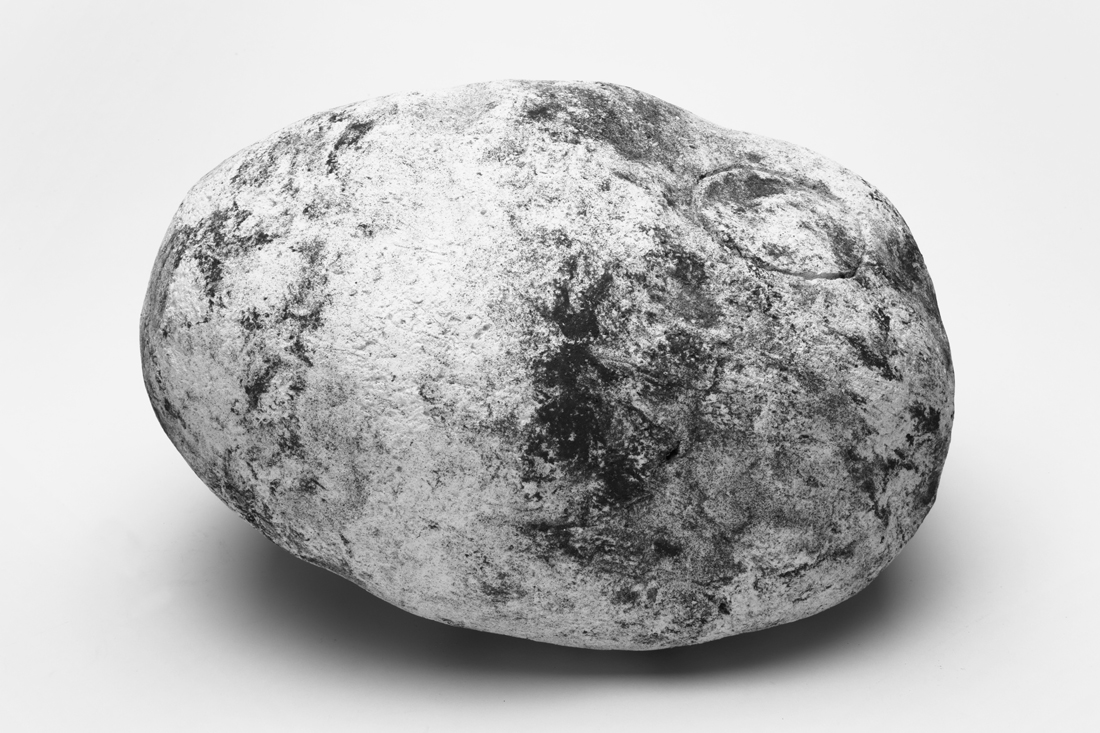
With this example we must imagine all this lying on a table. The stone is the only thing that is not a flat representation. The connections that becomes relevant here are many.  The images to the left are pictures taken by rain at night, holding the camera straight at the sky, the flashlight lightens up the rain drops. This related to the stone which is standing out of the table and is an object that can be touched. The fact that there is two relates to time. The blackness of the images suggest an act of looking into. The breast of the beautiful woman packed in black, relate to all other entities. Such as weight of the stone. Related to the the x-ray of a foot through the stone, Woman flesh, bone, stone, x-ray, look into, etc..

Clearly we can read alot into the relations between these four entities. But this as an example, or this as an research, makes us, aware of the importance, the possibilities, and what a good combination of images could lead to.

Research will be continued.


Duct-tape


Tuesday, June 1, 2010

In April we had a lecture from Ayumi Higuchi. The lecture was about her essay in which she investigates the impact rules have or can have on the process of cause and effect in the creative process.

To give us a visual example how the rules work, Ayumi let us make trees out of duct-tape.

Although it was not the goal of the workshop, it was really nice to see how quickly you could make a beautifull installation with tape. This inspired me to search more about tape and the artist who work with it.

Quick history

Duct-tape was developed during World War II in 1942. It’s a water resistant sealing tape with a standard width of 48 mm. It was used to repair military equipment quickly, including jeeps, firearms and aircrafts, because of it’s strength and it’s water resistand quality.

The original name is duct-tape but the soldiers in World War II changed it into duck-tape because the word duct-tape was to simular to the name for the cotton fabric they used for tents and rain clothing.

After the war soldiers returned home and took the duct-tape with them, to use it around the house. Since then it serves all kinds of perpuses. In the 1970′s duct-tape even made it’s introduction into spaceflights. When the square carbon dioxide filters from Apollo 13 failed, they used duct-tape to fix it.

This saved the lives of the three astrounauts on board.

Over the years duct-tape became a very popular product. People are making items out of duct-tape or decorate objects with it. You even have a lot of websites with information about how to make stuff out of duct-tape, and movies on youtube with instructions how to make it. Like this movie, that shows how to make youre one wallet out of duct-tape.

Increased interest in creating these novelty and fashion pieces has given rise to designer duct-tape handbags, wallets, belts etc.

Not only designers are interested in duct-tape. Also a lot of artist use it.

Click here for more of these installations.


Aaksh Nihilani

Also a lot of graphic designers use duct-tape. Within typography it even got a new name: Tapography. (also used for typography made out ofcasette tapes )

Artist Aaksh Nihilani is one of the artist who works a lot with tape. For the Arario Gallery in New-York he made three installations with duct-tape.

His explanation about the works:

“Since the show was titled Paraphrase, I took the opportunity to get into some tekst, tapography. I did ubiquitous words that we all encounter in our daily travels, especially as a New Yorker, but I wanted my paraphrase of the words to be aesthetically ‘better ‘than their original. So the words pull, push, and exit are all written out in tape, as well as simultaneously being shown acted out, or about to be (as in the exit piece). They were all a little bigger then human scale so as to more objectify their viewer rather than the usual other way around. I think these installations were particularly succesful because they stayed true to the site specific nature of the wordk that got me the show in the first place (i.e. Using the gallery’s door hinge to complete some of my lines), but also took on new levels of content in the figuration of the letters, and new concepts/processes of using the tape to express qualities like peeling and falling”


Autobahn

An other example of a tapografic experiment is tapewriter bu Autobahn. It is developed during a seminar by Richard van der Laken and Eric Wie, and later developed until a type specimin.

Tapewriter is a typeface that gets it’s form from the fence of a soccer-cage. The width of a role duct-tape is exactly the same as the room between two bars of the fences from thes cages. The thought behind this font is that any one who ones a role of ducttape can share their thoughts with the rest of the world.

Tapewriter showes that you can write with anything and that any surface can become your paper.

More information and the total typefase you can find on the website of autobahn.


Experiments with Duct-tape

Inspired by this all I started to experiment with duct-tape myself.  My first experiment was just to write something on the wall with tape.

After that I wanted to create a 3-d effect into space, wich I achieved to tape tekst to my window an fotograph it with the outside landscape:

In my last experiment I really wanted to go 3-d. So I made lines with yellow tape in the air and made letters with black tape in it. It creates

a very interesting effect because it looks different from each side. As you can see on the picture below and the title picture.

Inspiration and me – Danielle


Monday, May 31, 2010

Insearch of inspiration I’ve done a lot, and doing a lot but still I lack something. Something called perfection. Why I can’t see the perfection in my own work. What actually is the inspiration? Is it something what clicks between our eyes and the mind or something more? Something more that we can’t reach or is it just everywhere but hard to see till you are free.
I did research but still confused. So confused that I started to search for the inspiration in between my own confusions. Walked miles till my legs could handle, flew higher till I could fly, ran harder than I ever did, but still the inspiration is on it’s own place hidden but visible, visible because this world was once created with the inspiration, hidden because I can’t see it.

Is it only me who have got the problem finding the inspiration or others too? Been to the places and talked with people. It’s not only me (oh relief), there were more but sadly not everybody. Now I know, the inspiration is still there but need to work harder to reach the point so I can see it properly and perfectly. One night walked to the highest building, what I could find in my area, walked up, on the roof. And then stand on the edge of one corner, tried to look around, near, far, everywhere, thinking probably I will see the inspiration but accidentally I slipped, I felt like flying by knowing the fact that I was falling. While I was falling I met the inspiration, I was happy at least I met. Inspiration was my body laying on the ground for those who made an art piece of it, for those who gave everything to save me and discovered more ways to save life, for those who perfected there photography and for a lot in different ways.

Felt warm and light, opened my eyes, it was morning and I was on my bed, realized that I dreamed the horrible but inspirational. The first thing I did was bringing my dream alive on the canvas through the paints. Was happy to see my new painting what was inspired by my unusual dream. Finally understood that inspiration is not outside to search it’s inside, just need to feel it.

Leap into the void

So the point is, rules that are created are there but they mean nothing unless you don’t feel them inside of you.

Could there be a single rule explaining the whole World?

or

Will we ever find out?


There is no specific answer for any question. The reason our head is filled with brain is to think, and the brain never stops thinking, never stops creating new views. That is the reason why there can’t be a specific answers for up standing questions. After a decade those questions will remain the same but answers will be different because views will be different and that’s all because of the inspiration. Without the inspiration answers can’t be found, without the answers questions won’t be asked, without the questions we were not born and if we were not born then the almighty god knows what would have been happened to our earth, probably a new inspirational creature to think of for the god to create.

Sometimes I wonder, why we seek inspiration? Why we try to look for some specific things to inspire us? Why? Why? And a whole lot of whys?

While we know that it’s not something you look for. Let’s take an example of Sir Isaac Newton, an apple fell on his head and he got inspired, he wrote a whole book about gravity. Now, was he actually looking for that apple to fall so he could get some inspiration? No, he saw, he felt it inside, and his feeling became inspiration, inspiration became research, research became our source to know about the gravity.

If a single rule could explain the whole world then today we were still thinking that the earth is flat instead of round. Inspiration brought us to this point, to the point where we are now being able to walk on the moon, seeing the earth making round and being able to be proud for surrounded by the arts. Inspiration is art and art is inspiration.

Ants at Mars


Thursday, May 27, 2010

Ant robotics

During our first talk of a guest teacher, in the last design-period, I got interested in the way one could reach something really complicated by following some simple rules. We made tree-kind of forms according to a few rules, and however these rules where really simple we created quite complicated structures. I was questioning myself if this way of reaching complicated goals was also being used by non-artists, scientists, researchers, architects and maybe in nature as well. This is how I started my investigation and got to a website of a scientist named Chris Melhuish. He has got a lab at the university of Oxford, where he’s investigating ants ad robot’s together with ant-researcher Ana Sendova-Franks.


From a distance an anthill seems to be a lot of chaos. All the ants are just running around without a clear common goal and without noticing each other. If one would look more closely, his opinion won’t change that much. One ant is carrying some food or a larva to a nice looking place and another ant will just as easy bring it back to the beginning point. They just care about finishing there own tasks, and don’t care about what the other ants are doing.
An Ant has no sense of a higher purpose, and doesn’t know for what reason he is actually working. Therefore the organization of an ant colony is far too complicated. Nobody has got the survey and there is no unified management. Even the queen hasn’t. Some scientists are looking at ant colonies as being one organism, which exists out of a lot of smaller animals.

And so does Chris Melhuish, however some ants aren’t working that effective, as a whole, an ant colony seems who work quite well. After all they are living on planet earth for millions of years now. This antsystem has a lot of advantages for robots as well. Using a lot of small stupid robots solves for example lots of miscommunication if all the robots are just deciding themselves what they are doing, because mistaken tasks of a higher power won’t exist anymore. They are also more vulnerable when a higher power is deciding everything. If this higher power would pass away or something, they won’t know what to do any longer. Another big advantage of using a lot of small stupid robots is that it won’t cost lots of money to build them.

U-bot, one of the ant robots of Melhuish

Scientists are now thinking about the use of these robots at another planet or for the use of nanobots. In the case of nanobots, which are really small robots, it would be very useful to use simple robots that don’t need complicated soft- or hardware, because you just don’t have the space for it. You could for example use these nanobots in paint for bridges or buildings to discover small cracks in the paint or even to find weak spots in the iron. When using Robots on the moon or another planet it would be a really big benefit to use a big amount of cheap and simple robots. It won’t matter if one or two robots wouldn’t work or would get destroyed by landing at this planet.

Besides the technological use of these robots I think there are also great possibilities to use them in art. For example interactive art, because you can easily instruct these robots to complete certain tasks, while they will never complete this task in the same way. There will always be a certain randomness in the way they will complete their task. A second benefit to use these robots in interactive art is that it doesn’t matter in which kind of environment you will place them, they can work in any kind of environment because they react on the things that are happening around them.

The beauty of this system for me is that you don’t have to be effective to create an effective system while a lot of futuristic city-systems like Aurovile, discussed earlier at this blog, are based on pure effectiveness. One ant can carry some food or a larva to a nice looking place and another ant can just as easy bring it back to the beginning point, however at the end they will reach there final goal. Actually it’s a kind of anarchy, there is no higher power to check or instruct them, they have got all the information they need since their creation.

Something Else . . .


Saturday, May 15, 2010

THERE ARE RULES BEHIND COMPLEX AND ORGANIC CIRCUMSTANCES

This is the opening sentence of “Rules” a graduation essay written by Ayumi Higuchi in which she investigates the impact rules have or can have on the process of cause and effect in the creative process. A story that drags you into the exiting process of research where every question or statement leads to two others.
Using interviews as a platform to ask questions and create interaction, she involves Jan Groenewold (physician-chef), Luna Maurer and Jonathan Puckey (graphic designers), Snejanka Mihaylova (philosopher-writer-artist) and Peter van Bergen (musician-composer) to talk about the subject from the perspective of their specific discipline.
Look for yourself how she illustrates this story with many images and quotes dragging you deeper into the matter every page, creating in depth understanding. Munari, Wittgenstein, 9/11, John Cage, mixing politics with art and science with nature to get her point across.

Ayumi visited us in April 2010 to present a workshop in which she planted the seed of understanding using Bruno Munari‘s observations; [...] We can establish a rule of growth: the branch that follows is always slenderer than the one before it (Drawing a Tree).
Providing us with a trunk and applying two simple rules to it: The branch that follows must be slimmer than the one before -and- the tree must be symmetric, it quickly became clear that there are many rules behind complex and organic circumstances.

download this research essay: “RULES”, there are rules behind complex and organic structures

Crochet: presenting a new tool


Wednesday, April 21, 2010

As part of their program students of the Textile department TXT, are asked to research one textile technique –its history, its etymology, its philosophy– and give a lecture about it for a variety of different audiences.

René Shiro Grögli says: “when it came to my presentations of the technique I researched, I asked myself one question above all: What can I, and only I, tell the audience about my subject? What is there to tell that can’t be easily looked up on the internet?

Faced with a talk in front of 20 Rietveld Basic Year students, I decided to give them a crash-course in crochet basics. I brought 10 meters long fabric stripes for all the students and taught them how to do the two most simple and fundamental crochet stitches, the chain stitch and the single crochet, by using their hands as crochet needles.
My intention was to give them a tool that they would ideally use for their own projects. We only had a couple of minutes. The results are a beautiful series of small crocheted objects. Some of them are meant to be worn”.

concept/photo's by René Shiro Grögli /crochet results by students of B group

download this small collection [pdf] on classic and contempory crochet or look at my instructional slide show part 1 & 2
Get the Flash Player to see this player.

Realities


Wednesday, April 21, 2010

In our daily vocabulary we often use textile-related words in order to stress the importance of unity, collective work and all kinds of networking programms.
We knit and we knot quite a lot in language, as if we are experienced weavers and knotters, but most of the time we don’t have the slightest idea how you actually do make a knot.

vlechters-braiders

In this project students are researching one textile technique:
its history, its etymology, its philosophy

Since Plato used weaving loom as a model for how a state is operating, more philosophers are inspired to use textile techniques as a base for dealing with concepts. The question in this project is, how to liberate a technique from its tradition and its confinement.

"3 textile students will performe their research" is part of Basic Year design program

Maxell 90 Gold


Thursday, March 4, 2010

For me sound is something mysterious, because I’m deaf. during my childhood I was fascinated by music cassettes (casette-bandjes). People love these things. For me it was hard to imagine.
Something coming out of the cassette that I couldn’t see.
some more interesting elements:
– gold/black – variety volume of lines – symmetrical holes – two hole with teeth – rectangle with round corners – easy to put in pocket – parallel lines–

scale drawing “make invisible visible”

final presentation

Exploring the possibilities for translating the idea into a product brought me to a new space for viewing the designwork. I fell in love with the PET-foamboard material and thin woods. I could change the shape and lines (movement).
During the translating I solved the technical problems/errors that I couldn’t see in my scale drawing. I had to wear the showmodel glasses in order to solve these problems and find the right shape (nose-holding, hinge and degree angles).
I’m happy with my first design product translation from the (inaudible) cassette-band and I don’t mind wearing it.

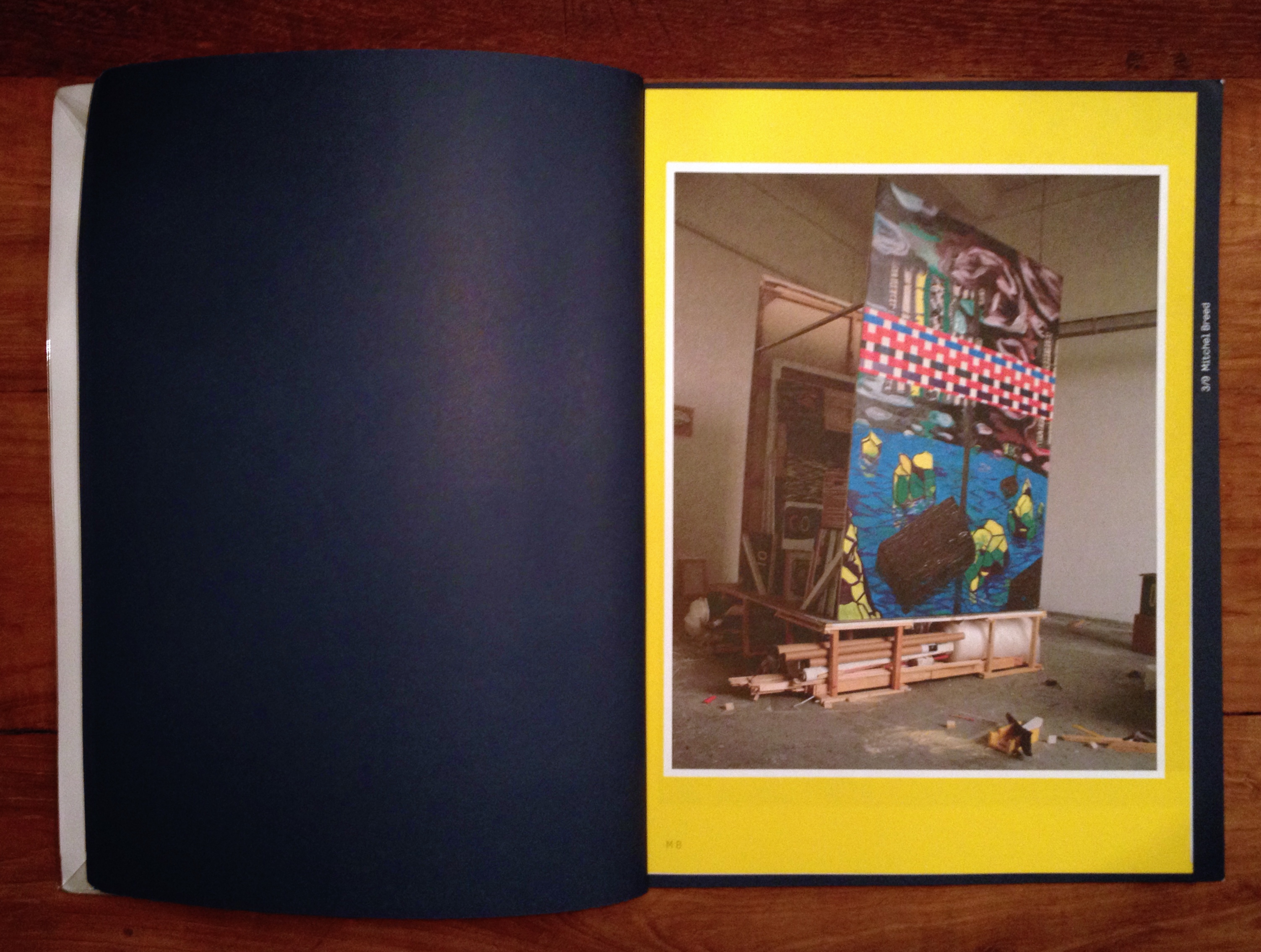
XX- ,The Book


Saturday, January 9, 2010

XX- is based on a research-approach that focuses on the intensive examination of typography and writing in all its social, societal and aesthetic ways of application. In the 2006 ‘typography class’ at the Leipzig Academy of Visual Arts, we (Elisabeth Hinrichs, Aileen Ittner and Daniel Rother) developed our project on the visual implementation of “symbols of power” in writing systems under the conditions of a totalitarian regime. In particular, we examined the way in which the SS (Nazi SS 1925-45) presented and visually legitimated itself by means of a constructed sign . A collection of sources was created on the basis of intensive research in libraries, state archives and the Internet as well as of interviews with contemporary witnesses. This collection was the starting point and the foundation of that book XX-, The SS-Rune as a special Character on Typewriters.

In its three chapters FEMALE (FRAU), SIGN (ZEICHEN), MACHINE (MASCHINE) the book XX- examines the way in which administration, communication and technology were an elementary condition of the functioning of the annihilation apparatus in the Third Reich.

The book’s content consists in visual (advertising and propaganda images, files) and textual fragments (contemporary, philosophical, sociological statements as well as statements related to cultural studies and encyclopedic entries). In it, history is interpreted, displayed and arranged. In this sophisticated way of dealing with history which makes its documents visible and discloses them for use the book XX- questions its sources and their perception. In its hybrid composition as a file as well as a book its design employs filing techniques such as a registry, catchwords, numeration and categorisation and embeds these into a book format.

The book XX- is composed as a symbiosis of a file and a book cover and thus refers to its sources: The archive and literature. Constructed solely of visual and textual fragments, it uses available literature (contemporary statements, encyclopedic entries, philosophical, sociological, political and linguistical standpoints as well as statements related to cultural studies) and images (advertising- and propaganda images of the 30s and 40s, files).

In the book, fragments are juxtaposed without them being commented in way resembling an archive. Thus, they demand an independent analysis and an autonomous evaluation of the different opinions by the reader. The selective constellation of the sources takes on the book’s structures: Their succession and compilation are fixed and thus generate a new content. The resulting hybrid presents history and questions its alleged absoluteness and unambiguousness at the same time.

The book XX- questions its sources and their perception In a sophisticated way of dealing with history that makes its documents visible and discloses them for use. Thus the closeness of the book as a medium is abrogated in favour of a new perception of historiography. History is interpreted,  displayed and arranged in a reflection of the medium.

by Elisabeth Hinrichs, Aileen Ittner, Daniel Rother

Title: XX- (The SS-Rune as a special Character on Typewriters)
Series: orange files. Studies on Grammatology # 1 [orange files. Studien zur Grammatologie]
Editors: Julia Blume, Prof. Günter Karl Bose, Institute for Book Design at the Leipzig Academy of Visual Arts [Institut für Buchkunst der Hochschule für Grafik und Buchkunst Leipzig] Leipzig 2009
324 pages, 198 images, 420 citations, hard cover, cost €49
ISBN: 978-3-932865-55-8

BibliOdyssey


Monday, January 4, 2010

Students of the Rietveld have many libraries at their service.
On top of the Public Libraries there are many specialized libraries covering many different fields of specialized interests. Designblog tried to give you some glance into Rietveld’s own small library by means of opening up it’s hidden treasures in two projects, called “The Library Project 2008″ and “Subjective Library Project 2009″.

Most frequently we continue our researches in the Library of the “Rijksakademie” especially when our search is art oriented. Their collection, dating back to the 18th century, includes approximately 33.000 volumes.
In addition to 85 magazine subscriptions and some 1400 videos and dvd’s, there is a large collection of monographies, catalogues of exhibitions and art theory books on visual arts, photography, video, applied art and architecture. Next to the regular collection it harbers a beautiful, exiting and inspiring special collection of rare and old book on a wide spectrum of subjects, including illustration, decorative art and others. Come in person and be awe-inspired.
The Rietveld itself squandered her special collection in the 1990ties due to lack of space and vision. Only a few items remained in their collection and archive. Stuff coming from collections like this can nowedays be found on many online blogs and sites too. Look at Designblog’s own links like BibliOdyssey (read more), Linedandunlined, Spacecollective and many others.

But there is no thing like the real thing.

The Stedelijk Museum Library is specialized on modern and contemporary art. This library is together with the Tate Research Centre and Bibliothèque Kandinsky/Centre Pompidou the biggest in Europe) and design subject of the 20th century).
The Dutch Institute of Media Art “Montevideo/Time Based Arts” (NIMK) mediatheque is the ultimate place for everything focused on video- and visual art. This Institute has a huge collection of video and a brought library.
Go there, take time and see for yourself.
The Bibliotheca Philosophica Hermetica is a highly unique library on manuscripts and printed works in the field of the Hermetic tradition that are mostly philosophical, theosophical, astrological, magical or alchemical in nature.
The Library of the University of Amsterdam (UBA/UvA) was founded in 1578, when the books and manuscripts of all catholic institutions and the city library were merged. Next to its main building at the Singel there are many other library collections (like Artis/Zoo Library) connected. Most interesting are their special collections (on printed matter and its history).
The International Institute of Social History (IISH) is the world’s largest documentation and research centre in the field of social history. The institute is independent and reliable, which makes it a natural depository of the frequently threatened cultural heritage of the labor movement and other emancipatory groups and currents. The IISH is an institute that comes under the Royal Netherlands Academy of Arts and Sciences.

Of course their are many more specialized libraries like the one in “Huis Marseille” on photography, the Academie van Bouwkunst and NAi (Dutch Architecture Institute in Rotterdam) on architecture and many others, never much more than a hour away by train. Most of them can be accessed on line like The Photography Library, a cooperation between FOAM (Amsterdam) and the Dutch Photo Museum (Rotterdam). For Fashion we just travel to Antwerp to visit the MoMu Library. Most students have free transport in the Netherlands.

Reviewed Printed Matter


Sunday, March 9, 2008

The International Institute of Social History (IISH) is the world’s largest documentation and research centre in the field of social history. Since its foundation in 1935, the institute has dedicated itself to the collection, preservation and availability of the heritage of social movements worldwide.


Situationist Pamphlet 1967

The  publication “Reviewed Printed Matter” is the outcome of a review assignment which was part of the theory program Critique & Actuality in the graphic design department of the Gerrit Rietveld Academie, 2007. The eleven-day program was compiled by Kasper Andreasen and was based on studying and understanding different methodologies of reviewing and analyzing printed matter; selected posters, pamphlets, cards and books from the archives of the Institute of Social History in Amsterdam.


Nieuwe Realisten Poster 1964 - poster archive - Letter for Iris- Number of silence

The International Institute of Social History holds over 3,000 archival collections, some 1 million printed volumes and about as many audio-visual items. The available Collections are accessible through an online catalogue, an online index of archives and inventories. The IISH is also home to a number of other documentary institutions, most notably the Netherlands Economic History Archive (NEHA) and the Press Museum. Both offer supplementary collections and services. Their material is included in the IISH catalogue. Visitors can consult the collections for reference and research in the reading room.

download this research reader: Reviewed Printed Matter

[initiated by Kasper Andreasen]


Log in