Skip to Content Skip to Search Go to Top Navigation Go to Side Menu


download >PARALLEL SCHOOL PUBLICATION


Wednesday, August 4, 2010

“Thus the story of pedagogy is more a story of love than a story of didactic materials”

This publication relates one week of activity among students from different schools and backgrounds who tried to work their way back to the basis of education. This could translate to something as simple as: one person meeting another, sharing and exchanging knowledge in a generous and disinterested way.

As a small entity alongside institutional education, Parallel School tries to explore and question the limitations of the former.

Without any predefined rules aiming to prevent failure or disorder, the participants in the workshop organised themselves as a group united by the goal of creating something together during one week, without knowing each others in advance. The experience can probably be considered “young”, i.e., imperfect and criticisable. Nonetheless, it embodies a common desire for learning without neither geographic boundaries nor hierarchical pressure, allowing for failure, leisure and pleasure to arise. If we shift the focus from the act of teaching to that of sharing, exchange becomes a necessity more than a possibility, and engagement is born out of the assumption of the fundamentally mutable and open character of the roles of teacher and student. Each participant explored his own expectations, initiated an activity trying to teach or to make the others discover something and finally ended by participating in an activity initiated by someone else.
The short time spent on each activity naturally led to more spontaneity and ingenuous curiosity than to a concern with systematicity. In any case, or perhaps exactly because of that, this was definitely an encouraging and motivating work experience through which self-centered interests in education were transformed into a collective and generous process of sharing.”

Parallel School workshop Berlin: 29/06 — 04/07 2010

> Download the publication
> More about the Parallel School Berlin workshop on the Parallel School blog
> this post connects to ‘Parallel Reading

TYPE CRUISER


Wednesday, July 28, 2010

The Type Cruiser / Ebay Auction is spearheaded by Simone Vollenweider & Anna Sartorius.
Within the last month they designed a new typeface which is available on Ebay till July 29th. Ebay (Typeface Cruiser HGB)
Part of the concept is that the font is meant to undergo changes throughout the auction: With each new tenderer a new special character will be introduced into the existing font such as a comma, question mark etc. Designers – that are not part of project yet – are encouraged to contribute to the exciting pool of characters by designing such a special character. The design of each new character is not subject to the existing typeface and is free of any rules or limitations.

The designers who are participating: Angelo Benedetto, Anna Lena von Helldorf, Anthony Burrill, Carolin Kurz, Daniel Gaffner, Daniel Peter, Dino dos Santos, Fanette Mellier, Jennie Winhall and Kathe Burn, Kerstin Finger, Hudson-Powell , Markus Dreßen, Martin Aleith (Pfandfinderei Berlin), Martin Sperling, Mathis Pfäffli, Node Berlin Oslo , Oliver Klimpel, Radim Pesko, René Siegfried, Silke Klinnert, Stephan Fiedler, Stephan Müller (Lineto), Thomas Ulrik Madsen, Yoann Betrandy, Mind Design & students of the Academy of Visual Arts in Leipzig.

More Informations Both, Simone and Anna, are enrolled at the Academy of Visual Arts in Leipzig/Germany and study "Systemdesign" with professor Oliver Klimpel.

the information man


Tuesday, July 20, 2010

Project based on a story told by American artist Ed Ruscha in an interview in NY Times 1972. Experiments inspired by this story were conducted and filmed. Project by Christopher West and Alban Schelbert [click image for movie]

Quoting graphic designer Julia Born from ‘Capsule over Kunst boeken’…

The information Man is an interesting story of artist Ed Ruscha, who tries to imagine what happens or has happend with his books. It deals with the live of a book. How it is used (or not), the book as an object etc…… This is what I always find interesting. The book as mass product, which starts to lead an individual life due to its distribution, changing its appearance too. I used this story for an assignment once and later it became the theme of the book ‘Beauty and the Book‘ resulting in a visual essay in coöperation with photographer Johannes Schwartz

Victory Over The Sun


Thursday, June 10, 2010

"Visual interpretation of Victory Over The Sun [click image for movie]

“Victory over the Sun” is a Russian Futurist opera premiered in 1913 at the Luna Park in Saint Petersburg.

The libretto written in zaum language was contributed by Aleksei Kruchonykh, the music was written by Mikhail Matyushin, the prologue was added by Velimir Khlebnikov, and the stage designer was Kasimir Malevich. The performance was organized by the artistic group Soyuz Molodyozhi.

The opera has become famous as the event where Malevich made his first “Black Square” painting.

The opera was intended to underline parallels between literary text, musical score, and the art of painting, and featured a cast of such extravagant characters as Nero and Caligula in the Same Person, Traveller through All the Ages, Telephone Talker, The New Ones, etc.

The audience reacted negatively and even violently to the performance, as have some subsequent critics and historians.”

Growing Chairs* footnote


Monday, June 7, 2010

In addition to my former post about Growing Chairs, here’s a small footnote – a project more close to home.

A fellow student in the Rietveld Foundation Year is Ana Oosting,who is working on her ‘free project’.  In this project, she works with growing materials. The essay she wrote about this subject  is relating to science,  focusing on bio art and art in a more general way. In her essay, she also talks about the more simply forms of this, in both nature and art, not specifically to be executed in a lab.

In relation to this essay, she made some pieces in which she experimented with growth – combining nature with art. In one of her works she let two doves build a nest on a pair of slippers (picture below). This changes the shape of the sandals as well as the way the nest is build.

Another work consists of growing different things on crystals. You see a scorpion in crystals (picture above).
Within her ‘free project’, Ana also worked with citrons (she tried to make them grow in different shapes) and she made an attempt to make graffiti out of moss.

In the same way as the designers – mentioned in Growing Chairs – are working, Ana is working together with nature to make interesting new art-pieces.

a small conversation between a Man and a Woman, starting from the workshop “Rules” by Ayumi Higuchi; rules in nature vs. rules in human beings


Saturday, June 5, 2010


To get to this conversation, I asked people around me to question something about the other gender, something the person questions the most (and if they didn’t know, just sOmething)

Mighty Market


Wednesday, June 2, 2010

Super Mighty Market

- Same rules but BIG difference ? Not all supermarkets must be created equal.

‘There is no other material a designer can work with that is so close to the human body and soul as the material of food’

Marije Vogelzang

Welcome to a new generation of spaces dedicated to food culture, where ? Located inside my very own head.  Please cross over to my ideal dreamworld as this space does not yet exist anywhere else. Over here I design a supermarket  – only it is not really just a supermarket – it is more of a space where design, art and food can meet – becoming more like a Mighty Market.

The dream begins with a beautiful architectural form screaming in need for a revival. The structure of what was once a beautiful spacious building whose glory has passed, now sits ghostly waiting in suspension like those christmas ornaments in storage that wait all year for december to arrive. In order to orchestrate the “revival” of my dream food space – it must not only have that “feel good quality” that makes you want to hang out there all day, but also allowing it to be inspiring and stimulating in a way that makes you think about how we relate to each other, our social food culture, how it’s context affects our behavior and choices.  Naturally, being a food lover – wannabe- healthy- eater myself as well as an art and design enthusiast, I became interested in finding a “glue” for all these to exist under one context of food culture and how its role affects our senses and perception.
In order to create my dream SUPERmarket THE MIGHTY MARKET I had to think about its social, psychological, chemical, technical and ethical core values. No employees but team members for starters. Environmentally friendly and with a fun attitude. I also didn’t want my supermarket to have the same old shoe box boring construction as most supermarkets do. I mean have you noticed how boring grocery shopping can be? So it definitely can’t have an uninviting interior like the cold, dark, dull, crowded interior in most grocery shops. My Dream Mightymarket has to be part renovation and part innovation – not just to refurbish and old existing iconic building such as one of ‘BEST’ old buildings but

a combination of both, bringing also new ideas of design into one unique place.

Small things make things big and even little changes to an approach can make a big difference. With this in mind,  I dream of the inside – it will be subdivided into areas such as a gallery for instance, where food exhibitions and lectures are given maybe  by someone like Daniel Spoerri who’s been an icon of the food art movement since the 60’s. A space in which I dream of bringing in people to host events like Marije Volgezand or Droog,  some nutrition specialists and chefs as well as artists and designers such as Ayako Suwa who’s emotional food art won her international acclaim in 2008 .

‘Designed by Marije Volgezand for a meal for Droog design, she hung the table cloth to the ceiling as a means to conceal signs of status like clothing. The meals were served on plates that had to be shared as she supplied the guests with unusual eating utensils for this purpose.’

Back to my dream. Incorporated but not occupying the same space you can find an area for home appliances that follow the same motto for innovative conscious design.  Everything in this alter- space-s is meant to make you feel something, and actually the whole supermarket is designed to make you feel something – in other words, it is designed to make you become aware of your senses. The rails for the stairs are cold to the touch to wake you up. Similarly all the senses are thought of in every detail of the stores design and even the lay out of the products is carefully thought through. From the lighting to the sound, even the sense of smell is incorporated to bring different sensorial experiences.  Some of the products you would see in this supermarket wouldn’t be the ideal healthiest, although its main focus IS the organic and healthy, and the selection of others redefined. Some of the products you can find at the Mighty market are for instance “EYE CANDY” by the Play coalition for Beta Tank who use something called sensory substitution to allow you to see images contained within the candy.

The packaging of products can’t stay behind and would have to be considered – it must aim to avoid sacrificing freshness amongst other factors in favor of warehouse storage as well as its reusability . Playing an important role as an example leader is ‘ Grown in transit’ by Design Academy Eindhoven graduate Agata Jaworska whose concept is simple: the food grows in the package as it is in transit to reach you changing the label from ‘best before’ to ‘ready by’.

At the eating area you would find ‘tasteful design’ and edible design pieces such as cutlery made out of food etc.. maybe since it is my dream, Nosigner would design the interior which would feature for instance his light unit “Spring rain” made out of bean starch vermicelli, which is edible when boiled (meaning no trash- zero!), or sell things like the ‘Unsustainable’ necklace by Greetje van Helmond for whom choosing food as material is a comment on the impermanence of fashion.

But the dream doesn’t end there. At the Mighty Market you can use books as currency which will eventually create the mighty market interactive library.

Wel bekome !

Hobo symbols and Rastafari language construct our fantasy similar to Cinema


Wednesday, June 2, 2010

Slavoj Zizek argues in his “Perverts guide to the cinema“, that each individual lives in a fantasy, fed by cinema. The role we play in society and the values we place on certain people, objects and situations are constructed by cinema. “If you are looking for what is in reality more real than reality itself, look into the cinematic fiction”(Zizek)

What is cinema actually? 24 frames a second. 24 images that visualize a story.  Usually accompanied by sound and dialogue to further visualize the story. So cinema tells us stories. And the stories create fantasies in the viewer.

However, we have not only started living our lives in accordance to fantasy stories since cinema. Story telling has been part of every culture. Through visual or literal means. It may seem like cinema is the most extreme way of story telling, as it can depict scenes in the most realistic way. However, as Zizek argues, cinema does not depict realistic scenes. It plays on the viewers fantasy. An example he gives is that porn depicts sex realistically. Cinema on the other hand, by hiding the obscenity, increases the erotic fantasy of the viewer even more. In cinema, the viewer is aroused through mere suggestions and everything around sex, not the act itself.


Jane changes clothes in silhouette,” from Tarzan and His Mate (1934) / “Percy changes his clothes” for The Dirty Weekender

The reason I bring this in, is that I want to investigate visual and literal symbols that similarly arouse the viewers fantasy through implying a story or some sort of meaning. Cinema is actually just a more complex alignment of symbols and construction of literary narrative. Therefore, Zizeks claim should also apply to more basic symbols and also language itself.

These images belong to a set of symbols used by gypsies and hobos. They would draw them on houses, street crossings etc. to warn and help each other.

What I found most intriguing is the hidden implications these symbols hold. The symbol meaning “woman living alone” holds a very dark implication. Even the shape of the symbol could suggest something sexual. Or the vulnerability of the woman, as this house can easily be entered.

A simple symbol like this can already visualize stories about rape, robbery or abuse.

This is what struck me when I came across these symbols, flipping through a book in one of our design workshops. However it is not only an insight into the brutal reality of hobo life. It also relates to far more recent developments. The recently censored site Rottenneighbor.com was a website launched in 2007, by Brant Walker. It allowed users to anonymously mark the houses of neighbours on google maps.


The concept of marking these houses has similarities to that of the hobo symbols.

Hobo sign for barking dog

The intensions and therefore the implications of these marks are different. The hobo sign is meant as a warning for when intruding into the property. The rottenneighbor entry seems to be more a way of letting out anger, a way of revenge.

In their function they are very similar though. The purpose of Rottenneighbor.com is to serve as advice for people choosing a new neighborhood to live in. This is very similar to the function of the hobo signs, although hobos would not look to buy or rent property, their signs also advise them about the safety of staying in certain neighborhoods.

On Rottenneighbor.com some entries also held similar implications to the hobo sign “woman living alone”.  There have been entries posted such as “Hier wohnt eine Schlampe, leicht zu haben und lässt die Tür immer offen.” a German post implying that the woman living in this apartment is easy to have and leaves the door unlocked. This post is an example for not going with the actual function of the website, of recommending neighborhoods. Instead it informs that there is something to get in this apartment. This makes its function even more similar to that of the hobo symbols.

This idea for an iphone application also plays on the idea of marking places to allow some sort of interaction with them. So the user would be able to search for, say, “a ’safe camp’ or a ‘Kindhearted Lady’ (a picture of a cat) and then have the iPhone show him the location.”

However it is not only visual symbols, that hold implications. Also language unconsciously creates and upholds values and stories.

To become aware of this in English language, it can be interesting to look at the language of the Rastafari. A culture that has been very conscious of their use of words and grammar.

The  language spoken by the Rastafari is based on Jamaican English. Its a creole language, which formed when African slaves were brought to Jamaica and had to adapt to the English of the slave masters. In their “reasoning sessions”, language was a big point for discussion and the Rastafari consciously changed it to rid it of any unwanted implications and meanings. “If you Really want to know how Rasta’s think, “Listen to them Talk” (Nicholas, Tracy. Rastafari A Way of Life pg.37)

There are three main purposes for which these changes in the language have been made

1) To be aware of the subjectivity of each individual and the unity of man

“I” replaces “me”

“Me” is felt to turn the person into an object whereas “I” emphasises the subjectivity of an individual.

“I and I” replaces the pronouns “him” she” “we” “you” and “me”

This change of grammar refuses the “objective case”, that which is acted upon.

It aims at seeing the subjective-self in each individual.

And showing the unity of man.

Inity replaces unity

Demonstrates a general pattern of replacing “you” and similar sounds with “I”. U is consideres negative as it sounds like “you”

Itinually replaces continually

It has the everlasting/everliving sense of I existing continuously.

2) To not hide true meaning, implications of words

Underpression replaces Opression.

Polytricks replaces Politics

Politicians as tricksters

Outvention replaces Invention

Mechanical devices are seen as outdated, and because it is the inner experience of being a Rastafarian that is invention.

3) To give words the positive implications they should have

Rising together replaces Falling in love

Everliving replaces Everlasting

Overstanding replaces Understanding

Referring to enlightenment that raises one’s consciousness.

Know replaces Believe

Rastas do not believe Haile Selassie is God and that they the Rastas are the chosen people. They claim to know these things, and would never admit to believing them.

Reasoning replaces Conversation

Any lengthy talk should not consist of conversing back and forth, but reasoning. Putting minds together to discuss anything from politics to sports or everyday life.

Sign In or Sign Up?

We should pay more attention to the values that are created around us. The art of story telling is constantly affecting our fantasy. Not only in cinema. Im not saying that language or images should be changed to give them more positive implications. But like the Rastafari, we could become more aware of their importance.

EVOLUTION = CREATION = BLIND POWER


Tuesday, June 1, 2010

In my case rules always bring a lot of variations I observe it  a long time because my way of working usually include one or more rules.Sometimes because I pick the rule but most of the time they are visible when work is finished.They reflect my present situation and feeling but for that certain amount of time they become rules and then variation of creating is visible.

It is not random that I found how this rules are already involved in me and I have no problem with it because rule is just a strong word- meaning most of the time something destructive but there is theory in biology which can very easily prove how rules are from the beginning a part of life and that they provide never ending variations of everything we are surrounded by.

Charles Darwin introduced us to his theory of evolution in 1859 with his book On the Origin of Species.

This theory is based on several rules which explain that it is working :

1, In nature of biological species exists variability and is partly hereditary

2, In this variation there must exist some species which are more and some which are less adapted to the condition of environment where they live

3, Species which are more adapted have bigger possibility to create descendants. And when this process is repeated for a longer time then certain type in certain environment will spread and this is called = blind power

4, Everything alive has last universal common ancestor

Example for a blind power is very simple:

Imagine that you are walking some field and you come across a stone, what do you think of is that ok is a stone and it was here or somewhere around from the begun, but now imagine you found a watch.Probably you take it and observe it, you check if it works, you find out that is a machine which measures a time, you see from which kind of parts it is made so it is sure for you that there had to be someone who designed it someone we call watch-maker. Existence of watch prove an existence of watch-maker. But this is the thing which Darwin challenged.He is tried to say that watch can exist without watch-maker.

The choice of nature can be called something like a blind watch-maker – he get some parts of watches separately and one by one he makes a watch from it.The thing is that he doesn’t know that he is making a watch.

Darwin was a very big observant and had a big possibility to travel around the world what makes him very rich of the materials he could used for his theory.

Another example of his theory which nicely explain also how rules of environment included food,weather… influence variability in this planet is his observing of birds- finches in the islands where he found out that they differ depending on what surround them and especially what differ is their beak – tool for eating. The reason is that finches split all over the different islands and by evolution they adapted themselves to the world around them and its rules.

Evolution begins with the first life in this planet and thats for me also where the creation begins and where the rules are always present and there is nothing wrong with it. The word freedom would never exist and would never have such a powerful meaning without the word restriction = laws.

To finish I choose the last part of Darwin’s book On the Origin of Species:

“It is interesting to contemplate a tangled bank, clothed with many plants

of many kinds, with birds singing on the bushes, with various insects

flitting about, and with worms crawling through the damp earth, and to

reflect that these elaborately constructed forms, so different from each

other, and dependent upon each other in so complex a manner, have all been

produced by laws acting around us.  These laws, taken in the largest sense,

being Growth with reproduction; Inheritance which is almost implied by

reproduction; Variability from the indirect and direct action of the

conditions of life, and from use and disuse; a Ratio of Increase so high as

to lead to a Struggle for Life, and as a consequence to Natural Selection,

entailing Divergence of Character and the Extinction of less improved

forms.  Thus, from the war of nature, from famine and death, the most

exalted object which we are capable of conceiving, namely, the production

of the higher animals, directly follows.  There is grandeur in this view of

life, with its several powers, having been originally breathed by the

Creator into a few forms or into one; and that, whilst this planet has gone

circling on according to the fixed law of gravity, from so simple a

beginning endless forms most beautiful and most wonderful have been, and

are being evolved.”


Italian Music for Movies


Tuesday, June 1, 2010

- click on image to download research pdf -

The Design of Our Reality


Tuesday, June 1, 2010

Perceiving Reality. Every experience that can be had is a probability within our consciousness. Our experience is created in the Mind and is always 1/10 of a second delayed from reality. This delay is attributed to the processing time frame that occurs in the brain. When we visually perceive our environment, the photoreceptor neurons in the retina collect the light (frequencies) and send signals to a network of neurons that then generate electrical impulses that go to the brain. The brain then processes those impulses and gives information about what we are seeing to the self-aware experiencer, the conscious Mind.

"Visual pathway through the Eye" / "Visual pathways in the human brain" Read the rest of this entry »

Formalistic relations


Tuesday, June 1, 2010

We are constantly surrounded by image, object and words.

Between them exist a relation. The table is picked in relation to the chairs, or painting in relation to your couch, if you are that type of person. But anyhow the relation between them are there, some more interesting than others. The type of relation I investigate is only based on the formalistic aspects. Not the symbolic meaning, morals, etc. Many questions then arise, in terms of relation. Such as: Is there a different relation between object and image, then between object and word?  The following, is a short research, investigation into these relations, which could help to understand our surroundings better.

Object in relation to image

In this example we clearly see that the image and object work together. But why do the do that? First of all, it has a lot to do with scale, the zoom, by this I mean the way we approach the image and object. And the scale between them, distance, you have to get close to see a small clip, and even closer to see the photograph. The clip is outside, and you look into or inside the photograph. The height of the photograph is almost same as the clip. The most visible shadow in the photo is similar to the clips shadow and
the vertical relief or outstanding line one the border of the clip is related to the out standing part of the cement in the photograph.
Also they both are related by text. The same type of visual text, giving information, date, product and name.

What is also interesting in the notion of object in relation to image is: the fact that when we look at something physical, which we have touched or been engaged with in our past. We have the memory how it feels to touch, its weight or surface. So by placing image of boxers in action wearing boxing gloves, with a pair of tomatos next to the image, we at once start to make a connection. Where boxing is about hitting flesh. The tomato in a way becomes both a relation to the flesh, (the inside and out side) and a connection to the red boxing gloves. So the tomatos and the image that is so far away from being connected subjectively, are strongly connected in a formalities way. Here the size also counts a great deal, I would say that the size of the gloves with inn the image, should match the size of the real size tomato’s. And another strong connection here is that the gloves and the tomato shine or reflect light in same way.

Word in relation to an image of an object

Here the word juice does not have any relation to the boat wreck in the meaning of subject. The distance in subject makes us more aware of the their formal relation, the way juice is written. By hand, not mechanical. The letters which do not have hard edges, resemble the form of a wooden boat. The repetition of the word clearly relates to the  way the boat is constructed, where the wood repeats it self, not as complete repetition, but according to the form of the boat. Which is also why the repetition of the words occurs. Not printed, but hand written.

Word in relation to object

In daily products, such as the milk carton we find the relation between the “typeface” that says milk, and the milk carton as an object. We find that some typefaces work better than others. The typeface we see here is chosen after the form of the carton. It has hard corners and ninety degree angels.

Entities with in a whole

With this example we must imagine all this lying on a table. The stone is the only thing that is not a flat representation. The connections that becomes relevant here are many.  The images to the left are pictures taken by rain at night, holding the camera straight at the sky, the flashlight lightens up the rain drops. This related to the stone which is standing out of the table and is an object that can be touched. The fact that there is two relates to time. The blackness of the images suggest an act of looking into. The breast of the beautiful woman packed in black, relate to all other entities. Such as weight of the stone. Related to the the x-ray of a foot through the stone, Woman flesh, bone, stone, x-ray, look into, etc..

Clearly we can read alot into the relations between these four entities. But this as an example, or this as an research, makes us, aware of the importance, the possibilities, and what a good combination of images could lead to.

Research will be continued.


Duct-tape


Tuesday, June 1, 2010

In April we had a lecture from Ayumi Higuchi. The lecture was about her essay in which she investigates the impact rules have or can have on the process of cause and effect in the creative process.

To give us a visual example how the rules work, Ayumi let us make trees out of duct-tape.

Although it was not the goal of the workshop, it was really nice to see how quickly you could make a beautifull installation with tape. This inspired me to search more about tape and the artist who work with it.

Quick history

Duct-tape was developed during World War II in 1942. It’s a water resistant sealing tape with a standard width of 48 mm. It was used to repair military equipment quickly, including jeeps, firearms and aircrafts, because of it’s strength and it’s water resistand quality.

The original name is duct-tape but the soldiers in World War II changed it into duck-tape because the word duct-tape was to simular to the name for the cotton fabric they used for tents and rain clothing.

After the war soldiers returned home and took the duct-tape with them, to use it around the house. Since then it serves all kinds of perpuses. In the 1970’s duct-tape even made it’s introduction into spaceflights. When the square carbon dioxide filters from Apollo 13 failed, they used duct-tape to fix it.

This saved the lives of the three astrounauts on board.

Over the years duct-tape became a very popular product. People are making items out of duct-tape or decorate objects with it. You even have a lot of websites with information about how to make stuff out of duct-tape, and movies on youtube with instructions how to make it. Like this movie, that shows how to make youre one wallet out of duct-tape.

Increased interest in creating these novelty and fashion pieces has given rise to designer duct-tape handbags, wallets, belts etc.

Not only designers are interested in duct-tape. Also a lot of artist use it.

Click here for more of these installations.


Aaksh Nihilani

Also a lot of graphic designers use duct-tape. Within typography it even got a new name: Tapography. (also used for typography made out ofcasette tapes )

Artist Aaksh Nihilani is one of the artist who works a lot with tape. For the Arario Gallery in New-York he made three installations with duct-tape.

His explanation about the works:

“Since the show was titled Paraphrase, I took the opportunity to get into some tekst, tapography. I did ubiquitous words that we all encounter in our daily travels, especially as a New Yorker, but I wanted my paraphrase of the words to be aesthetically ‘better ‘than their original. So the words pull, push, and exit are all written out in tape, as well as simultaneously being shown acted out, or about to be (as in the exit piece). They were all a little bigger then human scale so as to more objectify their viewer rather than the usual other way around. I think these installations were particularly succesful because they stayed true to the site specific nature of the wordk that got me the show in the first place (i.e. Using the gallery’s door hinge to complete some of my lines), but also took on new levels of content in the figuration of the letters, and new concepts/processes of using the tape to express qualities like peeling and falling”


Autobahn

An other example of a tapografic experiment is tapewriter bu Autobahn. It is developed during a seminar by Richard van der Laken and Eric Wie, and later developed until a type specimin.

Tapewriter is a typeface that gets it’s form from the fence of a soccer-cage. The width of a role duct-tape is exactly the same as the room between two bars of the fences from thes cages. The thought behind this font is that any one who ones a role of ducttape can share their thoughts with the rest of the world.

Tapewriter showes that you can write with anything and that any surface can become your paper.

More information and the total typefase you can find on the website of autobahn.


Experiments with Duct-tape

Inspired by this all I started to experiment with duct-tape myself.  My first experiment was just to write something on the wall with tape.

After that I wanted to create a 3-d effect into space, wich I achieved to tape tekst to my window an fotograph it with the outside landscape:

In my last experiment I really wanted to go 3-d. So I made lines with yellow tape in the air and made letters with black tape in it. It creates

a very interesting effect because it looks different from each side. As you can see on the picture below and the title picture.

Inspiration and me


Monday, May 31, 2010

In search of inspiration I’ve done a lot, and doing a lot but still I lack something. Something called perfection. Why I can’t see the perfection in my own work. What actually is the inspiration? Is it something what clicks between our eyes and the mind or something more? Something more that we can’t reach or is it just everywhere but hard to see till you are free.

I did research but still confused. So confused that I started to search for the inspiration in between my own confusions. Walked miles till my legs could handle, flew higher till I could fly, ran harder than I ever did, but still the inspiration is on it’s own place hidden but visible, visible because this world was once created with the inspiration, hidden because I can’t see it.

Is it only me who have got the problem finding the inspiration or others too? Been to the places and talked with people. It’s not only me (oh relief), there were more but sadly not everybody. Now I know, the inspiration is still there but need to work harder to reach the point so I can see it properly and perfectly. One night walked to the highest building what I could find in my area, walked up, on the roof. And then stand on the edge of one corner, tried to look around, near, far, everywhere, thinking probably I will see the inspiration but accidentally I slipped, I felt like flying by knowing the fact that I was falling. While I was falling I met the inspiration. I was happy at least I met. Inspiration was my body laying on the ground for those who made an art piece of it, for those who gave everything to save me and discovered more ways to save life, for those who perfected there photography and for a lot in different ways.

Felt warm and light, opened my eyes it was morning and I was on my bed, realized that I dreamed the horrible but inspirational. The first thing I did was bringing my dream alive on the canvas through the paints. Was happy to see my new painting what was inspired by my unusual dream. Finally understand that inspiration is not outside to search it’s inside, just need to feel it.

Leap into the void

So the point is, rules that are created are there but they mean nothing unless you don’t feel them inside of you.

Could there be a single rule explaining the whole World?

or

Will we ever find out?

There is no specific answer for any question. The reason our head is filled with brain is to think, and the brain never stops thinking, never stops creating new views. That is the reason why there can’t be a specific answers for up standing questions. After a decade those questions will remain the same but answers will be different because views will be different and that’s all because of the inspiration. Without the inspiration answers can’t be found, without the answers questions won’t be asked, without the questions we were not born and if we were not born then the almighty god knows what would have been happened to our earth, probably a new inspirational creature to think of for the god to create.

Sometimes I wonder, why we seek inspiration? Why we try to look for some specific things to inspire us? Why? Why? And a whole lot of whys?

While we know that it’s not something you look for. Let’s take an example of Sir Isaac Newton, an apple fell on his head and he got inspired, he wrote a whole book about gravity. Now, was he actually looking for that apple to fall so he could get some inspiration? No, he saw, he felt it inside, and his feeling became inspiration, inspiration became research, research became our source to know about the gravity.

If a single rule could explain the whole world then today we were still thinking that the earth is flat instead of round. Inspiration brought us to this point, to the point where we are now being able to walk on the moon, seeing the earth making round and being able to be proud for surrounded by the arts. Inspiration is art and art is inspiration.

The limits of my language means the limits of my world


Monday, May 31, 2010

The design lecture about rules made me think. Rules are based on agreements we make and understand. But, what is the function of language in this? And how does language relate to the world and to what we call ‘reality’?
I started reading the Tractatus logico-philosophicus, a book from 1919 by the famous Austrian philosopher Ludwig Wittgenstein. In this book a central question is: how does ‘language’ relate to the world i.c. reality? A question that does interest me and keeps me thinking.

Read the rest of this entry »

Vintage as a Vantage point


Sunday, May 30, 2010

Vintage

“Re-invent history, wear vintage”, a slogan that visually hits me while browsing through various vintage blogs online. The internet seems to have embraced vintage on its broadest scale, being a contemporary fetishized term for fashion and our continuous external enterprise. But a posting about vintage hairstyles( think Audrey Hepburn, Edie Sedgewick and Mia Farrow) made me think about vintage as something else, vintage as a vantage point for a multitude of areas, not just objects, but lifestyles and attitudes as well.
It seems as though all aspects of our past can be submerged into the nostalgia of vintage as a term and as an expression. The time element is crucial to explain why and what is actually classified as vintage. Used originally as a label of certain wines, vintage relates to specific grapes that were grown and harvested in a specified year, designating quality for some. The term becomes a symbol for exquisite taste, consequently a certain value is added, in price and demand. Vintage expanded in other areas of society during the last half of the 20th century as generations witnessed a rapid change in consumerism and global economy. Commodities lost their integrity as originality and uniqueness spiraled down the latter of mass consumption and reproduction. The spiritual value on personal items diminished as the availability in products grew homogeneous in its most pervasive forms, shaping a malady in western society of extreme objectification.

The myth of the movie star; hair-do goes vintage

It´s in our nature of always looking back to the past, either as way to water the soil for a new growth, a renaissance, or to point at faults to validate our presence to approach the past´s consequences for a better future. Let´s face it; overproduction and excess kill our sense of relationship with objects, whereas our grandmother´s closet might be the place which survives, for nostalgic and preservable reasons. Passing items on to new generations make them less mortal, meaning they´ll survive us and the increasing waste of cheap products we acquire regularly. Vintage exclaims soul and integrity, which points to the interest of vintage in the first place. The fact that vintage designs and clothing were created in the past, it exist a time period for items to grow into vintage, meaning it develops into a vintage state, and as a result vintage is a sign of growth and of belonging to a time we retrospectively inquire to for inspiration and aspiration. An increasing need for a closer relationship with our daily life suits this pursuit. The need for quality and uniqueness in products goes hand in hand with our need of being unique individuals. By acquiring vintage products, we are reflecting ourselves through a language of uniqueness as expression in the products. We feel more unique if we own unique items.

We´re constantly designing our life as availability and income supports a selective way of living. With vintage, one can classify or rather differentiate certain objects or designs from the rest of society´s mainstream market. It creates a distinction. Or one rather attains this distinctive aspect of separating oneself from the majority. Vintage is also associated with lifestyle, one add an extra element to your life. We embark upon a journey of image orientation, meaning we re-create or re-enact an image connected to the past. James Dean like lifestyle. The Beat generation´s poets influence on the intellectual youth, adding a specific trademark dress code; think hipster fashion without neon colors, a pre-8o´s hipster, relating to Allan Ginsberg and his contemporaries way of living and looking. RayBan´s Wayfarer for example were born before Tom Cruise saw his own reflection in them from Hollywood’s on-set film camera lenses in the 80´s. Hollywood and mainstream fashion have a tendency to pick up old codes for a new generation to re-mold into their own. Consequently, vintage design and clothing stores are today located in hip areas in big cities. An urban phenomena one could add, that merges our past with the present. It´s a business of its own, based on individual items, may it be garments from specific designer houses from the previous decades in the 20th century, 1920´s up til the 80´s. Or it be re-productions and copies of vintage design for nicer price tags. The vintage “look” can be acquired by anyone, yet the true vintage items, the high-value and unique ones are restrained to people who collects or can afford to buy the extra aura.

The thick frames, cigarettes and rolled up pants; ultimate vintage  look for men

The myth of the culture heroes; Mia Farrow and Veronica Lake´s hair-do and Beatnic Allan Ginsberg´s thick frames and rolled up pants. They represent an image or a lifestyle, molded into present day trends, making vintage a part of us- transformed from ideals and nostalgic decades, a sign of our present day mythmaking and longing for the past.

In 1995 James bought a t-shirt from the Coca Cola 1988 Olympics.  James feels that if something is genuinely vintage and personal, like our t-shirts, then it’s OK. We have grown old with them.

Thanks to James Westcott´s t-shirt, known as the mountain goat to many; currently a writer for OMA in Rotterdam, juggles art critiques and most importantly, a conquistador of global awareness.

Vintage Apparal

With Vintage, one can classify or rather differentiate certain objects or designs from the rest of society´s mainstream market. It creates a distinction.

Within apparel vintage has become an important part of the choice that people have in building their wardrobes. Vintage can be seen as an anti-movement to fast fashion and consumerism. Vintage pieces are often unique and carry a ’soul’ in them. The items had a history and this is what attracts people to them.
Vintage can be divided into several subdivisions, here are two of them

Vintage stores in amsterdam:

EpisodeZipper

Vintage — ironic hipster

the largest and most consumed division. these stores are mostly found in smaller shopping area’s where they attract a younger crowd of students and twentiesomethings. The stores are mostly overpacked with items, and decoration is often vintage related. The clothing tends to be a parody of past trends and iconic clothing items. people pair shirts with wolf prints and eighties addidas jackets. This whole movement has sparked highstreet retailers like H&M to actually copy the vintage and vintage look into their apparel to also attract this costumer. Whats apparent that within this segment its not about the authenticity of vintage but more about the aesthetics of it.

KabinetLadyday


Vintage — Labels

Here mostly collectors and fashion enthusiasts are active, the strive to collect the most coveted pieces and do research on them, aside from the collectable quality, these people are also interested in the make of the garment, because many of these garments are made in ways that are not utilized anymore due to expensive labour. Stores like these can be found in smaller shopping area’s in the higher segment, many of the store owners are collectors of vintage themselves and seek to curate their selection presented in the store. Many of these stores carry also vintage bags and other accessories like jewelry. Clients vary from young fashionistas to old ladies.  Also interesting to add is that many fashion designers scour these stores in search for items that they can incorporate into their own collection, many vintage items get copied and recycled into the current fashion landscape.

Ebay Vintage > FerryVintage

Movie > intersection: Manhatten Vintage

Fashion brands using vintage for their collection as inspiration and copies.

Maison Martin Margiela — ‘Replica’
Margiela scours vintage markets and stores to find items that can be directly copied into the house’s aesthetic. A label is included in the garment or shoe that this item is a replica. Additional info about where its found and material is also found in the label.

Other big brands
Several big brands employ research teams to find pieces as inspiration for their upcoming collections. In addition to vintage found outside they also use their own archives to draw inspiration from and reuse their old designs in new contexts.

TedTalk > Johanna Blakely

post by Marie Louise Jacobs — David Kulen

Growing chairs


Saturday, May 29, 2010

Growing your own design-chair, made out of living trees, grass or crystals – sounds interesting?

Nowadays, more and more designers are working with nature, instead of against it. They’re combining unpredictable, living objects with well-thought design and come up with new ways to make creative and durable furniture.

In a workshop, given by graphic designer Ayumi Higuchi, students had to create trees out of black tape. Every student received one role of tape and together they had to make a tree on the wall. It was interesting to see how this worked out – you’re able to control your own decisions, how and where to place the tape on the wall, but you can never completely control what the others will do with their roll.

This concept - not being able to direct the final outcome of a project- is closely related to the trend of ‘growing designs’. One could speak of an ‘eco-trend’, a form of slow design in the furniture-industry. In recent years, more and more designers experiment with the combination of nature, and the natural forms it grows in, together with practical and smart designs. We can see this most clearly in the design of chairs. Chairs that mingle the, in a way, unpredictable side of nature with the well-thought side of modern furniture design.

Just like with the trees made of tape, designers are using elements in their work that they can never fully control - and they do this on purpose, because it makes the outcome more interesting. One can only predict the way the final work will look like. And, commercially speaking, it’s a smart way of working. In the IKEA-era, a time in which identical chairs can be bought for just a few euro’s,  buyers are now looking for more unique, durable designs – they don’t want to see how the chair they just bought is also to be found in the living room of their neighboor.

Below, you’ll find some interesting projects that illustrate this new design-trend. All working very differently, they still show simular starting points.

First, there’s the work of Christopher Cattle that really shows the concept of taking the time to make an object, being very aware of the process of designing and being able to constantly make small changes in this process, to try to change the outcome. In this case it’s the use of growing trees, to make a small stool. The making of one can take about 5-7 years and you can make it bigger, stronger and higher by working together with the growing process of the tree itself. As you see on the image, the stool is made from three sycamore saplings that are ‘trained’ and grafted together around a plywood jig to form the tripod base of the chair. In an interview, Cattle points out:

Growing furniture […] can be used to demonstrate that it is possible to create genuinely useful things without adding to the pollution that industry inevitably seems to produce. Trees are self-generating […] It’s free and it’s non-polluting. Training and grafting trees as they grow are established traditional crafts, and wood is durable but it’s also biodegradable, so it doesn’t have to end up in a hole in the ground. I call this Grownup furniture as it’s the result of mature thinking.

Another project in which a designer is working with nature, is the ‘Venus Chair’ by Tokujin Yoshioka’s. This chair might not be that comfortable, it is a nice concept in which design and nature can get along. The object is made from growing natural crystals.
The Venus Chair is grown in a tank, the production process is half controlled by Yoshioka and half left up to nature, therefore giving space for interesting developments in the work. Yoshioka says: “I [...] feel that incorporating the principles and movements of nature into ideas will become something important in future design.
This is a prototype of his crystal-chair.

A work that is ready to use, is the design developed by Michel Bussien. It’s called the ‘Growing Chair’. It’s potted and on rollers, but you can of course remove the box and put it in your garden. A nice see-through chair, a very good example of letting nature, literally, fill up the design. To use the complexity and beauty of natural forms and include this in new designs - to almost ‘reconstruct’ nature, without having to bend and force the natural shapes in a dramatic way.

Also great for your back garden is ‘The Grass Armchair’, by Purves & Purves. Again, working with a frame, this chair is ‘leading’ the grass. It will almost dissapear in the landscape, being completely covered up with the surroundings, you’ll have to be careful while mowing.
The chair is made of biodegradable cardboard which you fill with gravel and soil, seed with grass.

Finally, this last example is made by the Dutch ‘Droog Design’. It’s the so-called‘Tree-trunk bench’ by Jurgen Bey. In his design ‘A fallen tree can serve as a seat. The addition of bronze classical chair backs makes it a proper piece of furniture, a crossing between nature and culture.
The designer makes clear, very firmly, that ‘it is ridiculous to transport trees when they are locally available.’
It is because of this statement that only the chair backs are for sale, thereby forcing the buyers to really find a tree, that’s already there, to use. Thereby making the buyer very active in the process of the design. Although this tree is not growing anymore, it’s still a nice way of using natural shapes and transforming it into a design.

All these projects show how you can make unique design in a new, eco-friendly way. A ‘movement’ that will probably set the trend for future designs and will constantly inspire designers to work in a creative way with what’s already there.

My grandmother and her weave


Friday, May 28, 2010

I want to tell you about my grandmother and needlework.

My grandmother had a big house and in one of the rooms she had a weave. On the weave she made tablecloths and carpets out of old sheets and fabrics. She ripped the fabric in to long thin strings and weaved them in to carpets. Some of the carpets she made where for her own house, some for the summerhouse and others to give away to family and friends.

My grandmother had an education as a nurse but after she married my grandfather she became a housewife. No busy work life for her but instead she had time to do different kinds of needlework an of course be a wife and mother. After her children moved out of the house she also developed new interest such as hunting to spend more time with my grandfather who was a keen hunter. But enough about her life story so far because this text is about the needlework she made and her as an example for a generation of woman and design.

The carpets she made are called kludetæpper in Danish, which directly translated means rag carpets in English. A better word for it in English would properly be patchwork carpets. The technique is that you ripe a bunch of old fabrics such as sheets or bed linen into long thin shreds about one centimetre wide. You then weave the shreds together again into rectangular carpets. The results is colour full thick carpets. When weaving you can also make patterns or motifs in the carpets by selecting the specific colours and then applying them in a pattern. The more traditional look of the carpets is a wide blend of colours without a specific pattern or motif.

A patchwork carpet my grandmother made

Read the rest of this entry »

Ants at Mars


Thursday, May 27, 2010

Ant robotics

During our first talk of a guest teacher, in the last design-period, I got interested in the way one could reach something really complicated by following some simple rules. We made tree-kind of forms according to a few rules, and however these rules where really simple we created quite complicated structures. I was questioning myself if this way of reaching complicated goals was also being used by non-artists, scientists, researchers, architects and maybe in nature as well. This is how I started my investigation and got to a website of a scientist named Chris Melhuish. He has got a lab at the university of Oxford, where he’s investigating ants ad robot’s together with ant-researcher Ana Sendova-Franks.


From a distance an anthill seems to be a lot of chaos. All the ants are just running around without a clear common goal and without noticing each other. If one would look more closely, his opinion won’t change that much. One ant is carrying some food or a larva to a nice looking place and another ant will just as easy bring it back to the beginning point. They just care about finishing there own tasks, and don’t care about what the other ants are doing.
An Ant has no sense of a higher purpose, and doesn’t know for what reason he is actually working. Therefore the organization of an ant colony is far too complicated. Nobody has got the survey and there is no unified management. Even the queen hasn’t. Some scientists are looking at ant colonies as being one organism, which exists out of a lot of smaller animals.

And so does Chris Melhuish, however some ants aren’t working that effective, as a whole, an ant colony seems who work quite well. After all they are living on planet earth for millions of years now. This antsystem has a lot of advantages for robots as well. Using a lot of small stupid robots solves for example lots of miscommunication if all the robots are just deciding themselves what they are doing, because mistaken tasks of a higher power won’t exist anymore. They are also more vulnerable when a higher power is deciding everything. If this higher power would pass away or something, they won’t know what to do any longer. Another big advantage of using a lot of small stupid robots is that it won’t cost lots of money to build them.

U-bot, one of the ant robots of Melhuish

Scientists are now thinking about the use of these robots at another planet or for the use of nanobots. In the case of nanobots, which are really small robots, it would be very useful to use simple robots that don’t need complicated soft- or hardware, because you just don’t have the space for it. You could for example use these nanobots in paint for bridges or buildings to discover small cracks in the paint or even to find weak spots in the iron. When using Robots on the moon or another planet it would be a really big benefit to use a big amount of cheap and simple robots. It won’t matter if one or two robots wouldn’t work or would get destroyed by landing at this planet.
Besides the technological use of these robots I think there are also great possibilities to use them in art. For example interactive art, because you can easily instruct these robots to complete certain tasks, while they will never complete this task in the same way. There will always be a certain randomness in the way they will complete their task. A second benefit to use these robots in interactive art is that it doesn’t matter in which kind of environment you will place them, they can work in any kind of environment because they react on the things that are happening around them.

The beauty of this system for me is that you don’t have to be effective to create an effective system while a lot of futuristic city-systems like Aurovile, discussed earlier at this blog, are based on pure effectiveness. One ant can carry some food or a larva to a nice looking place and another ant can just as easy bring it back to the beginning point, however at the end they will reach there final goal. Actually it’s a kind of anarchy, there is no higher power to check or instruct them, they have got all the information they need since their creation.
Eat sleep create?


Thursday, May 27, 2010

Detail from the flee
Detail of the Bayeux Tapestry,c.1066. People eat, sleep, breed and create.

In this post I will quickly address to a specific example and a specific theory that goes into this subject. Even though we do not see art as a necessity to life, as long as we life there tends to be creativity. Apparently they go together, they feed each other. How are they linked? Besides sleeping, eating and breeding, do we need culture? If it does not contribute to surviving, why is it there? Man has been carving in caves, painting in sand and weaving threads to tell stories that will survive us. You could say this is a pattern in human existence. If storytelling or archiving in either books or objects is a pattern, is creation equal to basic need? Researching this subject I found the Bayeux Tapestry to be a nice study case. Tapestry’s made at the time of the Bayeux Tapestry are often described as folk art. Folk art, a concept that is very well explained by Jean Dubuffet, typically embodies traditional forms and social values. It originally suggested crafts and decorative skills associated with peasant communities in Europe – though presumably it could equally apply to any indigenous culture. It has broadened to include any product of practical craftsmanship and decorative skill. Folk art has also a utilitarian characteristic to it. Utilitarian because it displays the life events of a collective, rather than an individual experience. This social or collective aspect of it makes it interesting to research in association to social behavior. When looking at cultural history there are bluntly put two ways to look at the history: through folklore culture and through ‘elite’ art culture.
Art in the 14th century was a male dominated field. Artists worked a lot for commissions, and painting can be seen as the biggest medium. It represents an elite culture because the elite financed most paintings. On the opposite the folklore culture deals with a great collective history. Woman, left on the shores while their man went out for wars or exploration, stood together and shared their lives in many ways. It is no wonder then, that most of the folklore art, made by these women in particularly, is usually subject to a specific event in their lives. The documentation we know nowadays, is the same as the folk art way of storytelling of these long last centuries.


Greec Vase 570 BC, Trajan Column Rome, Captain America vs the Axis of Evil, a message from the Minestry of Homeland Security.

Although you could argue that the Bayeux Tapestry is not an example of folk art, I would say it is. It is true that the tapestry was made as a commission and the ‘team’ of people who made it where highly classified workers who were selected to work for the state of England. But think about it. It is not about who made it that much, it is about the specific choice for this medium. Each medium talks and feeds our minds differently, not only visually. So the English King and Queen wanted to document this period of Great War. They could also have chosen any other medium besides tapestry. They could get a painter to make a huge war scene; they could pick a hero from the battlefield and give him a statue. But they chose for the medium of textiles. And there is a reason for this choice. The Bayeux Tapestry is made in this form so that the people could relate to it. It is made as a form of propaganda to underline connections between the English crown and the bishop at the time in England. Also there are small references to the Normandy regime, undermining their power and choosing a more heroic English version of the battlefield. The Bayeux Tapestry, or actually the real technique is embroidery, is like a modern propaganda youTube movie. Looking at it shows no difference to ‘real’ amature paste-up movies. In this case there is surely a strategy behind it. I do not want to go into this too much, or make it a conspiracy story, but it seems not more than logical to me that a mass medium is not always just directing the masses of the people. It can also be used to address the elite, because it appeals so much to the mass. Susan Sontag already wrote it in on photography. Amateur pictures and art photography are different. They talk different. But this difference is a strength you can use.

So from which desire does folk art come? In researching the essence of why we create the basic question first is what is there to create from? Philosophers have written many theories about how we perceive the world. Choosing one of the many, I focus on the theory of Lacan. It describes three ways in which the world is ordered. It is interesting because it suggests that the way we life, think, and create are prior to eating, sleeping and breading. This all comes from Lacan’s theory on the three world orders, being the real, the symbolic and the imaginary.
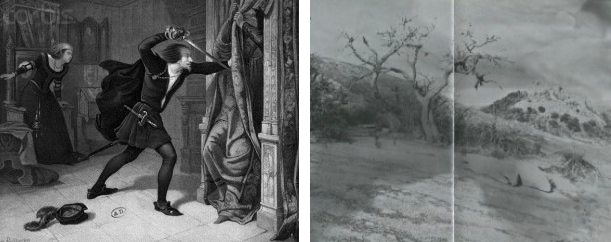
Lacan’s order of the Real finds a lot of similarities with the well known philosophical term ‘die welt an sich’. The real order is the objective outside world, known as a whole, without any conceptual boundaries set by language. This order always remains invisible for the subject, never to grasp. The symbolic order is the world the way we experience it through language, image, story, and so on. Every conceptual possibility in words is used to give form to the imaginary order. That imaginary order is the world of desire and fantasy. It is not only desire and fantasy as we know it in de Freudian way.
In Lacan’s theory the imaginary refers to every single subjective experience through the real. In the three orders it is clear that the imaginary order is something that is fundamental to our being. We think, or at least we would like to believe so. Every thought, desire, fantasy or whatever you experience non-materialistically fits into this order. But it did not come there by a gift of god. Like I said above, the three orders feed each other. Our experience comes from the real world, but what we notice of this is depending on the symbolic order. In a way the symbolic order determines what we explore of this real order. Then again, the imaginary takes all these concepts deriving from the symbolic order into consideration and is able to give some output.
This output needs a concept, definition, or even materialization to be noticed and to be justified. And this is the point were culture comes in. From this I understand that culture is like a snowball. It takes along things that stick, it leaves out things that don’t.  It starts small but picks up along the way and grows and grows and grows. When accepting this theory it is very logically that creation is a fundamental part of our existence, because we need concepts and objects to think. Without thinking we cannot react.
What for example the Bayeux Tapestry is showing us, is in a way nothing new to what we already know: we shape and create our own existence. This does not come after the first basic surviving needs of eating sleeping breading etc; it goes parallel next to it.

Ghost Science?


Thursday, May 27, 2010

During a workshop of Ayumi Higuchi about ‘rules’ I saw one of the books she brought with her to class. One of them was “Design as Art” by Bruno Munari. While reading, I noticed he was clearly writing in and for another era, but his ideas about visual, graphic and industrial design are still working. It’s a modern classic about how we see the world around us.  I have an obsession with modernism of an earlier era. I don’t know why exactly. But I know that something is haunting me. I constantly seek references of music, book, clothing and product design from the past. I wanted to write about examples of where I see these references, and what is it exactly that is haunting us and what enhances this power of haunting.

Lets start with Apple, almost everybody I know owns a macbook or an I pod. Most people don’t know that every single product at Apple, from hardware to user-interface design, is based on old designs for Braun during the 50s and 60s made by Dieter Rams. Jonathan Ive from Apple design is clearly inspired by him. Dieter Rams gives the clues for the products of the past present and the future of Apple, he is a furniture maker, architect and product designer.

Maybe a few of you are familiar with my next example, the magazine Monocle. Its an international magazine with its headquarters in London. Its more a book than a magazine, about international affairs, business, culture and design. Tyler Brûlé is Monocle’s editor-in-chief and chairman. He is the guy who brought neo-classic post-European modernism to lifestile publishing. Writers and photographers from over 50 countries deliver stories on forgotten states, political figures, emerging brands and inspiring design solutions. Monocle also works with impressive illustrators who contribute to the magazine periodically. Here are a few examples of illustrations made for the magazine.

Andrew Holder

Lab-Partners

Adrian Johnson

Notice the vintage inspired style and color composition. Few of the readers know that this is not the first Monocle. There was another Monocle , a virtually forgotten, but important magazine that was published from the late 1950s to the mid-1960s. the new Monocle however actually looks nothing like the old Monocle.

Maybe all this nostalgia is not for the recent past, but more for the future that it promised, but never came. I present you Hauntology. Hauntology is derived from haunt and ology.

Hauntology is the opposite of nostalgia. The term goes back to 1848. Marx and Engels stated ‘A sprectre is haunting Europe, the spectre of Communism’. It was introduced for the first time in 1993 by Jacques Derrida in his work “Spectres de Marx”. The future can only exists in relation to the past. We are living in a time when past is present, and the present is saturated with ghosts of the past. In hauntology, the present is not only haunted by ghosts of the past but also by  ghosts of the future. Jacques Derrida talks in the documentary “Ghost Dance” about ghosts being part of the future. In the documentary a student asks Jacques whether he believes in ghosts. He answers “Le phantom c’est moi”. In this case, yes it could be himself, since he is asked to play himself and without knowing it, he lets a ghost speak for him, he lets the ghost play his role.

Cinema is the art of ghosts, a battle of phantoms, its the art of allowing ghosts to come back, and let them speak for you. Watch the interesting documentary “Ghost Dance” (1983), starring Jacques Derrida.

My last example, hauntology can be found also in music. Recording label Ghost Box is an English recording label by graphic designer Julian House and musician Jim Jupp. They describe themselves as a label for artists that find inspiration in library music, folklore vintage electronics and haunted television soundtracks. The name Ghost Box itself is a reference to television and the way previous experiences with this medium can haunt your real-world experience.

I agree with Jacques Derrida that cinematography and telecommunication enhances the power of ghosts and their capability to haunt us. Music also contributes to this power of haunting. To prove it, listen to some of these examples of haunted music and let the ghosts of the past and future speak for you.

Memoryhouse

Broadcast and The Focus Group

Mordant Music

Grammatical System Investigation (GSI)


Thursday, May 20, 2010

What is perfect? Is it complete, non-existant, precisely accurate, pure, to improve, unattainable? What are these words such as ‘perfect’ about? When it comes to communication, can language in general explain what we are trying to say? What words are chosen to express this meaning? In the historical sense grammatical languages have been developed and evolved. Is there a constant factor to be found in these different languages?

Perfect is a word from the English language. It can be a verb, a noun or an adjective. These are devisions made in the dictionary, where you can trace back words. Some words in it equal other single words, others are described by several words. This is how ‘perfect’ is equaled by several words, but for example ‘couch’ can be equaled by one word, ’sofa’ (a type of furniture). But by referring to a couch, also the frame of the type of furniture can be aimed. In the theoretical meaning of language, ‘grammar’ is a name for the study, description and explanation for everything that involves the system of a natural language or an artificial language.

Grammar is a term derived from
the Greek word:
(grammatik techn) which means “art of letters”,
(gramma) which means “letter”,
(graphein)which means, “to draw, to write”.

To study language a structure of words and sentences are used that are defined by a set of rules. These rules can function as a sort of pattern to relate to the meaning or the logic in language. This is how a description of the word perfect could have a totally different meaning for any person individually. When a baby is born into the world, it has not learned a specific language yet. It can communicate through sounds. By repeating sounds the baby could learn a grammatical language. Other people can teach it, by using this system of words, that they once learned in the same way. Grammar can also be a way to express the system of a specific language. This can be a formal-mathematical description, a way to describe the language itself or in another language, or a combination of these forms. To translate a formal-mathematical description a formal system can be used. In grammar these systems function as well as in math and logics. They consist of the following elements:

- a finite sequence of symbols that help to formulate formulas
In grammatical sense an alphabet helps to create words. Each alphabet has its own sequence of symbols. In the word p e r f e c t i o n each letter is a symbol and a part of the word or sequence.

- a grammar that prescribes how well formed formulas are formulated.
The words that are put together by the letters of an alphabet according to a defined set of rules. In the following example ‘pre’ has in every word (or formule) the same quality. The rule ‘pre’ is the pattern. It can be recognized like this:
prefix
previous
prepare
preview
prevent

- a sequence of axioma’s or an axioma schedule
This is a proposition that is not proved or demonstrated but self-evident.
In the formal system new expressions are being abstracted from older ones. The older expressions that assumed are called axiom’s, the new expressions are called propositions.
‘pre’ is a Latin (or Greek) prefix that is used in the Latin language as well as in English. The word ‘pre’ is equivalent to the word ‘before’, although in this sense it cannot replace ‘pre’ in the words above.

- a rule that abstracts a proposition from a number of propositions
These propositions are being called premises and the subtracted proposition is called the conclusion.
“Perfect is a word” is a true proposition
“Perfect is a sentence” is a false proposition
“Perfect is cute” is a contingent or random proposition
“Is this perfect?” Is a question, not a proposition

Conclusion: ‘Perfect’ is a word, it is not a sentence. ‘Perfect’ could be called ‘cute’, although it is a random proposition that cannot truly logically define it.

In logics proposition statements are either true or false. In this way it is right to say that ‘perfect’ is a word. This does not apply for, for instance questions, desires or exclamations. If the statements are true or false can be unknown, as long as the question: ‘Is it true?’ can be asked usefully. So is it useful to ask if the proposition ‘Perfect is cute’ is true? ‘Cute’ is a adjective that describes in this context, not an equal meaning, but a subjective meaning to ‘perfect’. Also in different languages this word may have various understandings, although the same type of word is used.

The English language is spoken as a primairy language in Australia, Belize, New-Seeland, Nigeria, The United Kingdom and The United States of America. As a secondary language it is spoken in a much wider range. Almost half of the grammatical English language is originally from Germanic and Roman languages. When Germans invaded Brittain 450 After Christ, they brought their language with them and so the Old English was formed. Then the history of English evolved when colonies were founded in North-America around 1600. The language developed within a different setting. Nowadays the American English changes under the influence of media such as television and the Internet. Emigration, invasions, mass media, and for example wars have caused the absorbtion of external words into existing languages. In this sense finding the origin of words could explain something about the history of the world.

The grammatical history of the word perfection lies in the Latin word ‘perficio’; in English the meaning is ‘to finish’, ‘to bring to an end’. The word perfect (io) in this sence means literally ‘a finishing’ and perfect(us) ‘finished’.

information:

http://home.hccnet.nl/am.siebers/woorden/framewoord.html

http://www.answers.com/topic/perfection

Me, You and Alexander van Slobbe


Sunday, May 16, 2010

Exhibition flyer

This spring I went to visit the exhibition “fashion for thought” at the Centraal museum in Utrecht. The exhibition was containing the work of fashion designer Alexander van Slobbe.

In the end of this interesting, and well curated exhibition, Alexander van Slobbe showed one of his patterns for a dress, with all the materials needed to copy it. I decided to make a project out of this dress and went right after the exhibition to buy fabric.

choosing fabric

I chose a black, transparent fabric for my dress.

Alexander Van Slobbe works a lot with the fabric, not forcing it into any direction, on the contrary, his way of designing really follows the direction and weaving in the textile he uses.

In my reinvention of the design of Alexander Van Slobbe, I would like to work, like Alexander van Slobbe, by draping the fabric. To find inspiration, I therefor looked up two of my favourite designers, Diana Orving, who works a lot with draping, and “House of Dagmar”, a designer collective who´s design is based on stitching.


left: Diana Orving, middle and right: House of Dagmar (www.dianaorving.com; www.houseofdagmar.se)

When I looked at the patterns I copied, I saw that the size was to big for me. Therefor, so that I can more easily work with draping, and to make the dress my size, I started to make a tailor’s dummy.

Instructions how to make your own tailor´s dummy

Material: tape, scissor, plaster bandage

  • wrap your self in tape. Not to tight

  • cut it open

  • tape it together again

  • cover it with plaster

  • while starting the cutting process, I realized what a difficult fabric I had chosen. It was to thin. When making the hem, and cutting it, thin fabric gets really easily wrinkled. I had to put a cotton ribbon between two layers of the fabric to be able to complete the hem, both in the sleeves and the collar.  After stitching and unstitching several times, i could finally start with the drapings.

    back of the dress front of the dress

    The most problematic part was the making of the collar. I called my parents for advice. My mother told me that her mother  used to cut very thin fabric on the diagonal when making a collar. By doing so, the weeving of the fabric lyes in the “wrong” direction, and therefor the fabric stays in place.

    My grandmother would be horrified if she could see my way of working with the dress with the unregular stitches and the cutting in the fabric. She was a teacher for dressmakers and always knew who should wear what and how. She used to design clothing from private orders by rich ladies in the 50s. Actually my other grandmother, the mother of my dad, was also working within fashion. She was a sewer, and her sister a fashion designer. But I guess I lack the patience and interest in mathematics to work with sewing. On the other hand, the fashion designer Diana Orving, sketches directly on the dummy. She didn’t have any training in pattern construction. She just began by putting fabric on a dummy and register the way the fabric was falling.

    I don´t know why I like drapings so much. Maby I see it as reaction against garnment wich only aims to bring out the body, clothes that are not interplaying with the fabric nor with the person who weares it. This kind of fashion is very excluding. It´s only made for people who are happy with their body, or only think that they are beutifull if they show their body parts because of objectification. But working with drapings goes further than that. It makes us aware of the importance of the fabric. It makes us see the handicraft and how gravitation creating shapes through the fabric. What Alexander van Slobbe does, is that he manages to balance the drapings through simple lines, forms and colours. It never becomes to much.

    By choosing a black, thin fabric I tryed to do the same. The belt in the waist, and the  narrowing of the lower part of the dress brings out the classical shape of the woman body.

    By making the décolletage in the back more low-cut than in the front, the dress becomes sensual without revealing to much.

    So this is the result. Now it´s  only Me, You and Alexander Van Slobbe!

    Parallel Reading


    Saturday, May 8, 2010


    Dear fellow student,
    I have been for a couple months gathering from friends and writing myself Parallel reading reports*, brought together as two PDFs, around the quite broad themes of (self-)education and the death of the author.

    Dear_dear_dear_fellow_student_and_reader.pdf 1 - Le Lecteur / Collectif, Nathalie Piégay-Gros • 2 - “The?Extasy?of?Influence: A Plagiarism”, Jonathan Lethem • 3 - Composition n° 1, Marc Saporta • 4 - Fahrenheit 451 — plagiarism, Stéphanie ?Vilayphiou • 5- “The?Death?of?the?Author”, Roland Barthes

    *: PARALLEL READING REPORTS are personnal notes written along the reading of a text, image, artwork, lecture, exhibition (anything goes) in order to remember it better. They can be simply handwritten and scanned, continuous text, drawn or layouted; disect the source or give a personal interpretation. The only important thing is that they avoid showing the original material and end up being shared!

    **: PARALLEL SCHOOL OF ART is a virtual and international school where people who want to self-educate themselves can share what they are doing and thinking, as well as their interests and projects. Parallel school wants to generate and spread work emulation, and to develop self-initiated projects such as publications, meetings, lectures, workshops etc.

    Jules Estèves

    — More details, documents and reading reports on: http://www.parallel-school.com
    More by Jules E.

    Idealistic intentions


    Friday, May 7, 2010

    Idealistic intentions

    All over the world idealistic ideas about ecological, peaceful communities and city’s rise up with the intention to create a new world and to design a new society and mentality that would chance the world. Nature supporting architecture, religious like rituals, education, economic and social structures are developed to amplify the realization of this new and “better” world. In every such project that was developed until now, cultures come together in a fusion of art, education, rituals and tradition. It is clear that a lot of people have the desire of a new structured, new spiritual and in every aspect more organic and ecological world. One that gives us the peace of mind that we will not use up our energy sources, that we will not exterminate our nature and therefor importantly to most humans ourselves! Every kind of media is trying to inform us to be aware for the need of change throughout the hole world. To raise the question of awareness, in what way do we go on manipulating the world, in what way can we change our living conditions. It is even a big inspiration for the art world, television series that create science fiction out of it, writhers, designers, architects etc…

    Utopia’s

    Some reactions to all of this have bin the design and building of Utopia’s. Still up until today non of these “Utopia” projects seem to really succeed. It is an interesting question to why these projects fail time after time and still why so many projects are rising up. It is a question that I will give my own perspective on. I will take two cities as an example for the experiment for the improvement of a better quality of live.

    Auroville

    “Auroville wants to be a universal township where men and women of all countries are able to live in peace and progressive harmony above all creeds, all politics and all nationalities. The purpose of Auroville is to realize human unity”. In there philosophy they try to wave cultures and societies together with traditional and modern lifestyles. In that way Auroville has become a playground in many area’s such as architecture. Not only does Auroville have an interesting architecture it has it’s own economical structure, a research area for renewable energy and recyclable energy and elements, it’s own social structures and developed education.


    The sketch of Auroville ‘1965’ begun with Mirra Alfassa (who was collectively called “The Mother”) she laid down the basic concept for the town. Here first sketches are called “The Galaxy” in witch she tries to lay down all the important activity areas that would fulfill the vision of making it a universal township.  It was to be a city that would totally intergrade and be submissive to nature. Then in 1970 Mirra Alfassa asked Roger Anger to begin with the design of the center “Matrimandir” the hart of Auroville. This is the most and very important  building of Auroville. It is called the “soul of the city” and is situated in a large open space much like an arena called “Peace”. Inside the building there are 4 pedestals that all belong to a wind-region North-East-South-West and symbolize characters. And also a mediation hall, this contains the largest glass globe in the world. Above it is a hole in the roof so that the sunlight shine’s s straight line into the globe by daylight. Witch gives it a extraordinary glow and light spectacle.


    Every building has a symbolic meaning. The city exists out of 4 zones (cultural, international, industrial, residential) and a green belt. The movement of the city became to be intergraded in the nature it was build in. Around it other communities came into existence. Thus a kind of double city gradually developed. Auroville starts weaving into a structure of it’s evolution and become one pattern. The city has relied on the possibilities that nature trees and plants gave room for to build, and because of that a very natural shape became to be, almost tornado like, if it was made and shaped by nature itself.

    This all came to be in the order of a charter of rules that where developed to the being of the City. Some of the architectural rules:

    1. Not to Harm nature or its existing habitants in the build of the city
    2. Eco Friendly Architecture
    3. Climate responsive architecture
    4. Architecture integration with natural surroundings

    The following link is to the architectural aspect of Auroville: http://www.auroville.org/thecity/architecture.htm

    Chandrigarh

    Here I want to make a bridge to Chandrigarh another city that was build in India. This city came to existence because in 1947 Punjab was divided into a Pakistani and Indian part the new Indian state therefor needed a new capital city. The architect is Le Cobustier who also created the Modular formula and his own charter’s of rules for architectural constructions.

    Some of Le Cobusier values:

    1. Architecture that has a moving relation with light, shadow and space.
    2. Provide of cheap and high quality buildings
    3. To contribute to a more comfortable and easy lifestyle
    4. To connect people by the use of elements and natural senses

    These formula’s had everything to do with the natural elements.Le Corbusier had an aversion for industrial like cities, he thought it led to crowing, dirtiness and lack of moral landscape. He tried to intergrade a way of architecture that suggest and encourage people to have a certain lifestyle. He was also very concerned with the human body responding to its architecture. Also the feel and touch of materials and shapes, color, space, sounds, light where all even as important. The city Chandigarh pronounces itself as a city where modernization coexists with nature’s preservation. Tree and plants are as much a part of the construction plans as the buildings an the roads. And he city is surrounded by a green belt.

    The most important and symbolic monument is an metal 85 feet hight open hand that rotates in the direction of the wind and carries out the message of peace and unity “open to give and open to receive”. Much like the symbolic meaning of the centre building “Matrimandir” in Auroville. Also Chandrigarh is divided into different area’s witch are self-sufficient neighborhoods, that are linked to each other by roads and path networks. The zones are numbered from 1 to 47, with the exception of 13 (since it is considered unlucky). The shape of the city is much like a patchwork blanked. It is clear that the city, roads and networks are organized and designed for practical use and comfort.

    Failure and Succes

    Both cities show in some way’s a lot of resemblance to each other but are also very opposite to each other in a lot of way’s. Both city are divided in sectors that have there own function, witch is also very important to both city’s is the richness of nature. In both city’s the architecture is build with a very friendly approach to the human body and environment. And both cities contain symbolic elements. But where Auroville wants to be a total new economic, ecological and self sufficient city and break loos of commercial and mass production companies, Chandigarh has companies like Mc Donalds etc… The mentality and philosophy differs in a economical, spiritual and educational way. Auroville tries to contribute to a solution for our problems of pollution of our environment, our energy sources and the quality of our mental and physical health. Chandrigarh tries to have a quality of living environment but does not in the hole try to change the use of economical and commercial consumers with the outcome of a more nurturing use of our environment. Still Auroville has not provide a solution and is now surviving on neighbor-villages. If you look at the world as a symbiotic organism it is clear that one can not survive without the other, everything is linked to each other. Even within the smallest organic cels and atoms there is linkage to everything around us. We humans have designed and created a world full of problems that are totally linked and symbiotic to each other. If we take one of them away the survival of function as we created it is in danger. In order for a concept like Auroville to work there has to be a chain reaction throughout the hole world to maintain that symbiotic relationship that we have with the world in order to survive.

    It is very clear now in the scientific world, the spiritual world, the business and economic world, that a change and chain reaction like that is very necessary for our survival. Money became digital and lost its value and creditability. Banks are falling, oil one of our biggest sources of energy is running out. There is a big hole in the ozone-lear that damages our  bio culturals. We have to find a way to make a solution possible. And finding this way is very inspirational for designers all over the world!

    Realities


    Wednesday, April 21, 2010

    In our daily vocabulary we often use textile-related words in order to stress the importance of unity, collective work and all kinds of networking programms.
    We knit and we knot quite a lot in language, as if we are experienced weavers and knotters, but most of the time we don’t have the slightest idea how you actually do make a knot.

    vlechters-braiders

    In this project students are researching one textile technique:
    its history, its etymology, its philosophy

    Since Plato used weaving loom as a model for how a state is operating, more philosophers are inspired to use textile techniques as a base for dealing with concepts. The question in this project is, how to liberate a technique from its tradition and its confinement.

    "3 textile students will performe their research" is part of Basic Year design program

    Auspicious Tangents


    Wednesday, April 21, 2010

    FAMILIAR DOMESTICS

    Most living spaces use textiles as membranes and interfaces. When we sleep at night we inhabit an almost entirely textile place. We imagine extending familiar textile aplications into the built environment to create fully integrated textile architecture inspired by biological systems.
    One of the domestic textiles we have been focusing on is a window covering. Making such a design responsive alow it to grow, metabolise and synthesise with qualities in its immediate surroundings. It can be light emitting, temperature regulating, structural and adaptive.
    Folowing along this trajectory is a world of materials that truly facilitate the relationship between the inside and the outside. They are no longer inert matter, but active and able to respond to stimuli such as light, heat, water and electrical energy


    Geophysical Log: Location: Loop.pH studio London UK Date: 10/04/2007 Time: 22:12:39


    GEODESIC DISTANCE

    Looking at plants spinning, weaving and knotting themselves around features in their environment, we cannot but think how they inspired humans to manipulate fiber and thread.
    It is the nature of many plants to climb and attach themselves tangentially to establish a structurally stable and energetically efficient link. In the image below, can be seen a knotted end of a tentacle that a passion flower uses to anchor in space.
    The two black rods are a fiber composite and part of a woven space-frame we are developing for plants to grow into and consume. The space-frame uses tangential joints exclusively and could easily be scaled to fit many life-form’s requirements.


    Geophysical Log: Location: Domestic Things, Flow Gallery London UK Date: 18/03/2007 Time: 12:37:55


    INTERDEPENDECE VS. DEPENDENCE

    A woven textile is an example where many individual fibres, weak when singular, provide great strengh in unison as they interlink and cross one another. The language of textiles is often used to describe systems in our world that overlap and work together to create a harmony.
    The construction of fabrics can be described as a parallel for co-existence and inter-dependence in a sociological context. An urban fabric is interwoven with people, neighborhoods, homes, work places and institutions an a community is strengthened when diversity is present.

    tangent (raaklijn) . go off at a ~ (een gedachte sprong maken)

    Selection of 3 texts out of 10 by Loop.pH [Mathias Gmachl and Rachel Wingfield], published in "Responsive Textile Environments" edited by Sarah Bonnemaison and Christine Macythe Canedian Design Research Network. source: Over/Under, Under/Over . notes . Txt(textile) Department . June 2008

    Something Else . . .


    Tuesday, April 20, 2010

    THERE ARE RULES BEHIND COMPLEX AND ORGANIC CIRCUMSTANCES

    This is the opening sentence of “Rules” written by Ayumi Higuchi. An essay in which she investigates the impact rules have or can have on the process of cause and effect in the creative process. An story that drags you into the exiting process of research where every question or statement leads to two others.
    Using interviews as a platform to ask questions and create interaction, she involves Jan Groenewold (physician-chef), Luna Maurer and Jonathan Puckey (graphic designers), Snejanka Mihaylova (philosopher-writer-artist) and Peter van Bergen (musician-composer) to over the subject from the perspective of their specific dicipline.
    Look for yourself how she illustrates this story with many images and quotes dragging you deeper into the matter every page, creating indepth understanding. Munari, Wittgenstein, 9/11, John Cage, mixing politics with art and science with nature to get her point across.

    Last week Ayumi visited us to present a workshop in which she planted the seed of understanding using Bruno Munari’s observations; [...] We can establish a rule of growth: the branch that follows is always slenderer than the one before it (Drawing a Tree).
    Providing us with a trunk and applying two simple rules to it: The branch that follows must be slimmer than the one before -and- the tree must be symetric, it quicly became clear that there are many rules behind complex and organic circumstances.

    “Rules”: essay by Ayumi Higuchi


    SI Module or total table design


    Tuesday, March 23, 2010

    SI Module is the portable platform for Applied Arts and Autonomous Design, initiated by Sandberg Institute Applied Arts department.
    On a special table a system of modules will be build. The sizes of these modules are variable, depending on the size of works exhibited.
    SI Module, was part of Object Rotterdam


    three more links inspired by the design fair: Object Rotterdam
    1•Odd Designs on Film, 2•Richard Hutten "playing with tradition", 3•Total Table design
    The Object Rotterdam excursion was part of the Basic Year "form-lab" workshop


    “Prenez soin de vous”


    Monday, March 15, 2010

    For the first time in fifteen years an overview exhibition on the work of the French artist Sophie Calle is organize in The Netherlands. Central work in this exhibit is “Prenez soin de vous” (Take care of yourself), in which Calle invites 107 women from a ballerina to a lawyer to use their professional skills to interpret an email in which her partner breaks up with her.

    Sophie Calle is part of the April 1st BasicYear Design Trip
    look for more on Sophie Calle
    newspaper article NRC  9/5/2008 (dutch) pdf

    INFODECONDITIONALDATA


    Monday, March 15, 2010

    The screen sees me the whole time while I am looking at it, I am not embarrassed by it, it is neutral, invisible even, I don’t register its existence,
    it is just a glowing surface.
    The screen is inextricably connected to my life. It is a door that I pull shut behind me, which gives me access to a space where I can disappear. It is my gateway to information, it is my space for communication, it is a space where
    I carry out my work and enjoy myself.
    I entered into this connection and I am addicted to it.

    For 9 months, starting in April 2009, our laptops took a portrait photo through the built in webcam and a screenshot of our desktops every 5 minutes while we were using it. We have arranged and displayed this enormous amount of imagery in the hope that both patterns and details will become visible.

    INFODECODATA is part of the April 1st BasicYear Design Trip
    more on Conditional Design

    Scale 1:15


    Monday, March 15, 2010

    HUDSON MUSEUM is part of the April 1st BasicYear Design Trip
    more on the Hudson Museum

    shape


    Monday, March 15, 2010

    There is a period in everybody’s life where one is still unable to speak. It’s the time, your very early childhood, before you ‘re taught a language. In that period, you look at every object as what it is, not at the function or the meaning it might have. That is a way of looking at things I really like. Later when you’re encouraged to speak, you loose your ability to look at things ‘as they are’, because you start giving names to things. You start naming things and thus start categorising things.


    There is a certain kind of break in your existence, from now on you look at things and try to lable it, you don’t see it as an original and unique whatever-it-is any more. The French psycho analist Lacan (who made a very complicated theory about all this) calls this phase the symbolic order as apposed to the other phase that he calls the imaginary order . Very revealing stuff, if you ask me.

    Our workshop was about shape, not meaning. The thing as it is, not the concept behind it. An attemt to try and let you look at an object in the way described above.

    Judging from the results that can been seen under the category “form-lab“, presenting most of the processes I witnessed, I think it worked at least for some of you.

    legs are nice


    Monday, March 15, 2010

    legs are…


    Process of transformation one thing to another is long and full of difficulties…

    What if object we chose is so beautiful and well done that we don’t want to change even a single detail?

    I think that nature is the best designer*

    Object design seems to be separate being. It is living its own life.

    In my project, I would like to add simple everyday objects invented by the human imagination – bedside table made part of infinite perfection of nature – human legs.

    * ( ok, some small dogs are sometimes a little bit odd ).

    Come and read!


    Monday, March 15, 2010

    The aim of the project was to be capable of using the shape and quality of one object for developing another, completely different object. I decided to use my favorite chair as starting point for the assignment. While working I realized that I couldn’t solely rely on the factuality of forms. Rather I had to work on a more intuitional level; I had to interpret and translate shapes and texture into certain qualities.  I ended up making a bookshelf out of a chair.

    Some general remarks on the chair:

    • 50ties
    • The chair can be divided into two parts, namely the seating and the legs. The parts differ in style and function, yet they seem to contrast each other in style -hard and soft, different movements-.
    • The chair is top heavy.

    Qualities of the seating:

    • The round shape of the seating gives a sense of intimacy and protection.
    • The round shape has an inward movement that is inviting and suggests openness. It makes you want to sit down and crawl up into it.

    Qualities of the legs:

    • Straight, elegant legs.
    • The legs have a vertical movement. The legs are scuffed all around and they seem to narrow down towards the end which also gives them a slight horizontal movement.
    • Breaks with the softness and inviting feeling of the seating.

    Left: photo of the chair and the seating. Right: different sketches bookshelf

    Left: photo of the chair and seating.
    Right: different sketches of the bookshelf.

    Idea behind the bookshelf:

    • The round shape and inward movement of the bookshelf corresponds with the seating of the chair.
    • The shape of the bookshelf gives a sense of intimacy and protection, which is also similar to a book cover.

    The idea behind the books:

    • The books are placed with their covers towards the bookshelf, which gives one a peak into the books by just looking at them. The placement of the books is a literal expression of openness.
    • The pages of the books are meant to contrast the round shape of the bookshelf, similar to the way the legs and the seating of the chair relate to each other.

    As can be seen in the sketches above I experimented with the general form and feeling of the object by placing the books in different ways into the bookshelf. Ultimately I had to conclude that the last sketch (the books placed in a crown shape) is corresponding best to the heavy, warm feeling of the chair. Furthermore the crown shape of the books helps to enhance the qualities and the shape of the bookshelf as they are reversed in form.

    Several sights of the bookshelf -the actual result.

    van pen naar trein


    Monday, March 15, 2010

    what is happening


    Wednesday, March 10, 2010

    how can a line be straight from one angle, and curvy from another?

    I turn the watch over and look and turn again.

    what is happening?

    it is all angles and shapes,

    it’s all curves and lines,

    its all male and female,

    unexpected angles, unusual proportions.

    I can keep discovering.

    This watch is the property of science fiction classics and uniformed airline officers in the future we will all have microwaves and flying cars

    and this desk

    The Oily Object


    Tuesday, March 9, 2010

    Simplistic form, makes me think of suitcases, briefcases, boxes.

    4 angles from the front side and back side. 8 in total.

    Design of simplistic form. Based on angles.

    Obvious similarity with the zippo. Detail from the side put on the top.

    Very minimalistic outcome. For me it’s about aesthetics.

    Red Glass And Orange Text.


    Thursday, March 4, 2010

    Deformed Text Graphic element Kikkoman's universe

    Transparent
     Deformed letters and symbols when you look through the glass
    Reflections

    brother and sister

    Another object that fascinates me is a lamp.
    Today I came to realize that they actually are brother and sister.
    Two elements:  Shiny transparent fragile glass - vs - Strong non transparent cap/top
    
    Symmetry    -    yrtemmyS
    As less as possible. Form follows function. No extra’s.

    Exit

    A Sketch
    
    Sketches
    
    
    Product Follows Form

    sketch of how it will look

    No extra's: Lamp and switch are now one
    Reflections are now replaced by light

    The Model

    Balance
    
    technical drwing
    Logical symmetrical system
    
    (Eventually) two elements: Plastic and Glass
    
    Or four? Lamp and Switch included

    Maxell 90 Gold


    Thursday, March 4, 2010

    For me sound is something mysterious, because I’m deaf. during my childhood I was fascinated by music cassettes (casette-bandjes). People love these things. For me it was hard to imagine.
    Something coming out of the cassette that I couldn’t see.
    some more interesting elements:
    – gold/black – variety volume of lines – symmetrical holes – two hole with teeth – rectangle with round corners – easy to put in pocket – parallel lines–

    scale drawing “make invisible visible”

    final presentation

    Exploring the possibilities for translating the idea into a product brought me to a new space for viewing the designwork. I fell in love with the PET-foamboard material and thin woods. I could change the shape and lines (movement).
    During the translating I solved the technical problems/errors that I couldn’t see in my scale drawing. I had to wear the showmodel glasses in order to solve these problems and find the right shape (nose-holding, hinge and degree angles).
    I’m happy with my first design product translation from the (inaudible) cassette-band and I don’t mind wearing it.