Skip to Content Skip to Search Go to Top Navigation Go to Side Menu

"Gerrit Rietveld" Tag


THE ALPHABET OF GROUP A


Wednesday, October 31, 2012

The Alphabet of Group A

The main language we speak in group A is English and mostly the communicating language on this earth, but there’s of course many other languages.

In Group A we have Arubiano, Danish, Dutch, French, German, Spanish and South Koreean Nationalitys.

The students name below are in alphabet form that makes it easier and faster to search for the name you attempt to search.
Last name to first name in alphabet form from A to Z

Last name

  1. Arco Johanna
  2. Arnardottir Maria
  3. Barlinckhoff Anne
  4. Chuard Nicolas
  5. Dinther Jessy van
  6. Galama Jorik
  7. Goldbech Rikke
  8. Jang Aram
  9. Kuijl Thi-Lien
  10. Liimatainen Mira
  11. Nagler Floor
  12. Oduber Natasha
  13. Peterson Chelsea
  14. Ryliskyte Agne
  15. Schraven Mari
  16. Sjoerd Schunselaar
  17. Sjøberg Jakob
  18. Vasquez Callo Rodrigo
  19. Westbom Weflo Anton
  20. Zürrer Selina

First name to last name in alphabet form from A to Z
First name
  1. Agne Ryliskyte
  2. Anne Barlinckhoff
  3. Anton Westbom Weflo
  4. Aram Jang
  5. Chelsea Peterson
  6. Floor Nagler
  7. Jakob Sjøberg
  8. Jessy van Dinther
  9. Johanna Arco
  10. Jorik Galama
  11. Mari Schraven
  12. Maria Arnardottir
  13. Mira liimatainen
  14. Natasha Oduber
  15. Nicolas Chuard
  16. Rikke Goldbech
  17. Rodrigo Vasquez Callo
  18. Selina Zürrer
  19. Sjoerd Schunselaar
  20. Thi-Lien Kuijl

Shared interests


Monday, June 4, 2012


In this research i collected exciting materials and information, i compared it to other data that in a certain way related with it and questioned with this his decisions and my thoughts about the project.

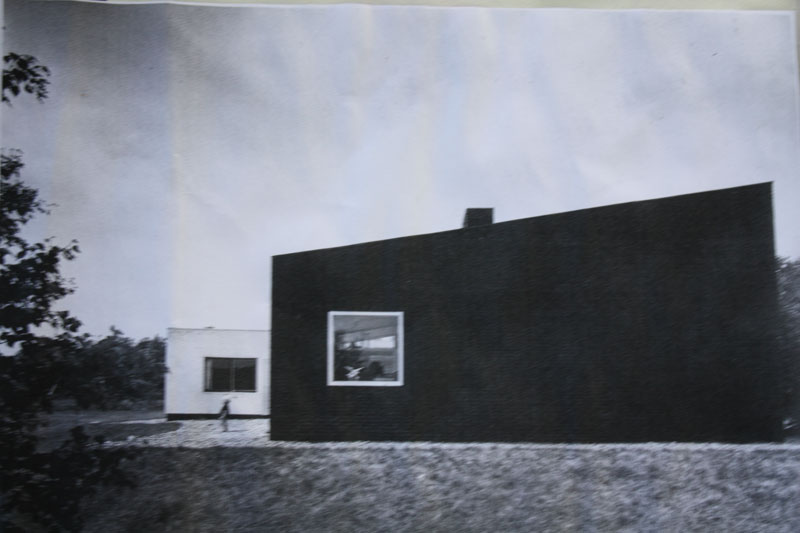
What appealed me to start this with this project is the difference in between the first intentions and sketches and the actual outcome. The sketches look great but not very Gerrit Rietveld, the outcome (or at least the exterior of the house) looks kind of normal and look far from what I expect from a guy like Gerrit Rietveld. Never the less i like it a lot.

SharedInterests_BvandenBerg

Rietveld knew his lines


Thursday, November 24, 2011

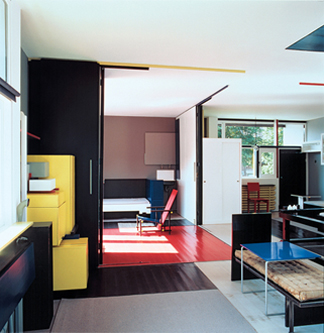
Two years ago I was building a model of a chair. After I have stared in 50 minutes of a detail of two black straight lines at the chairs back, my friend asked me: ”Julia what is it about your lines? There is only a difference of one centimeter?” I didn´t know what my problem was, but I knew this centimeter was a critical part if my chair would communicate or not. When I visited Rietveld Schröder house I got reminded of the situation with my friend. Every centimeter of the house was dynamic. The Schröder house with its characteristic bright colors and construction touched me. I could relate to myself in the aesthetic expression, but what do I have in common with the way Rietveld was working with the Schröder House?


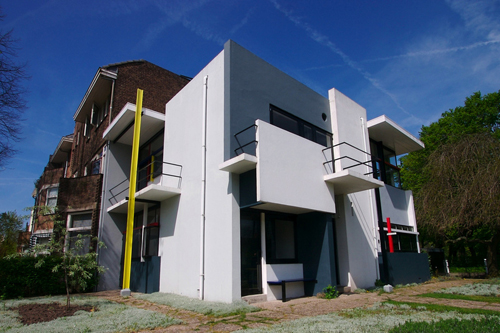
Mrs. Schröder let Gerrit Rietveld design a house for her and her children. Rietveld and Schröder worked with the original idea together but Rietveld decided about the color and form. Mrs. Schröder wanted to have the interior with an open space that was customized for her everyday activity. Rietveld created a house that combined this everyday life with a playfulness. The house is made like a coordinate system of flat surfaces and straight lines. He used geometry och mathematics as a tool and trusted his feeling when he created the form. Gerrit Rietveld could feel if a form was working or not. He was only using geometry and mathematics as a tool. He was thinking in three-dimensional terms and sketched in 3D. His first model was made of solid wood which gives character to the building. The second model was made of cardboard, glass and matchsticks which is different from clay that usually is used as model material.


He worked asymmetrical when he composed volume of the different surfaces. One rule he used was that the lines should not be perpendicular or parallel with each other. This is associated with his feeling of three-dimensional forms. He could feel when the planes have the right position.


He worked playful with the surfaces. When he was working with overlapping he always let one line continue in front or behind the other one. I believe that if  a corner had been formed it had been a static expression. Some surfaces were slotted in the facade so it visually looks like they go into the wall. He built volume by letting the flat surfaces be slotted into each other. The Schröder House has multi intersections for the structure, but the main reason for that solution is aesthetic.
For Rietveld it was more important to create volume with space, then the material with which it is built. He said “The reality which architecture can create is space” (The work of G. Rietveld architect; Theodore M. Brown; A.W.Bruna & Zoon, 1958).


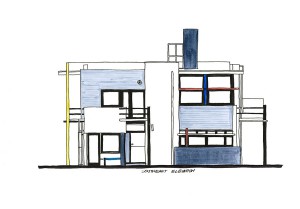
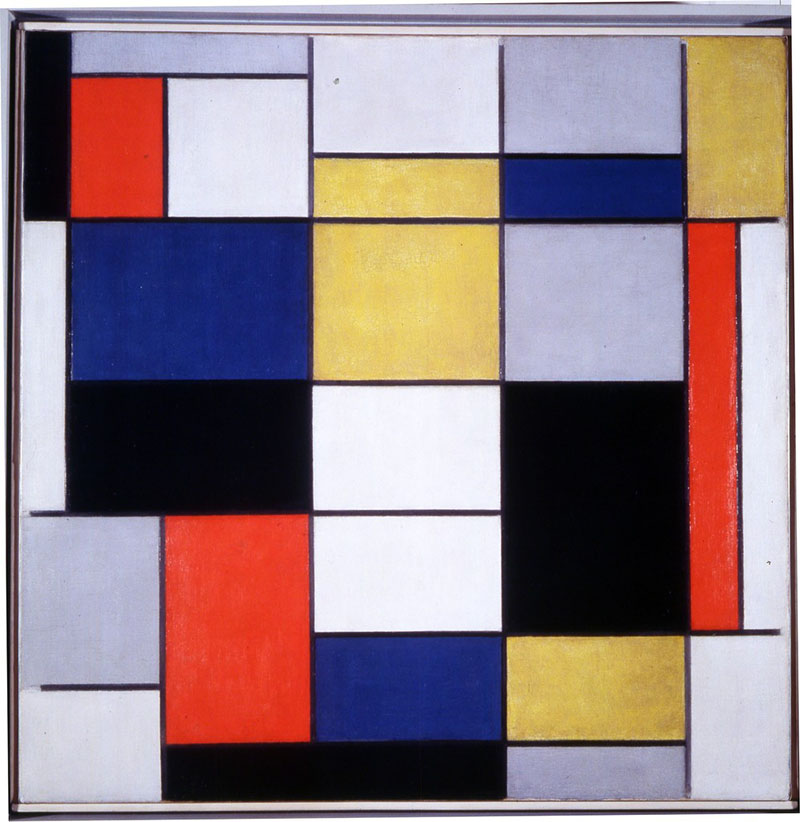
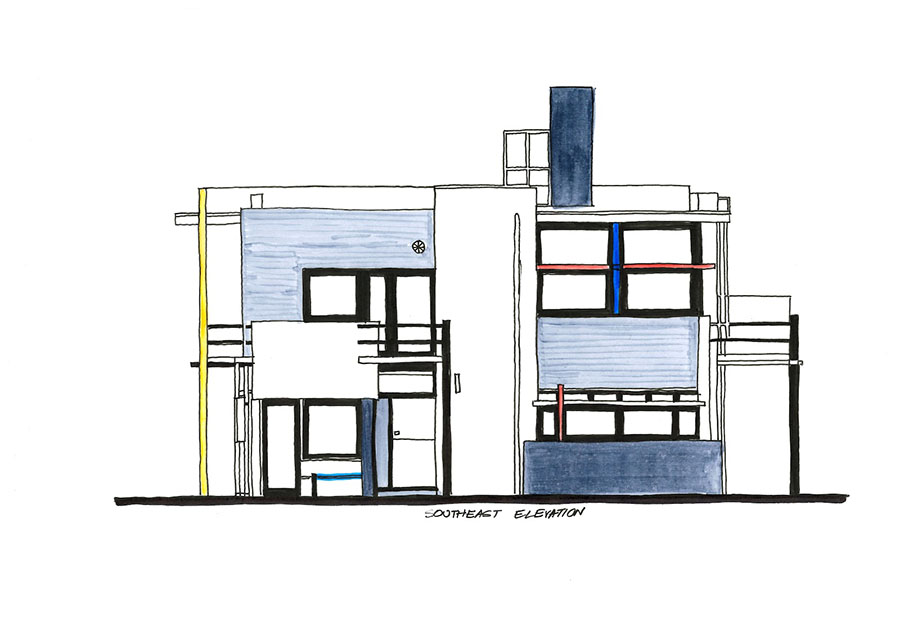
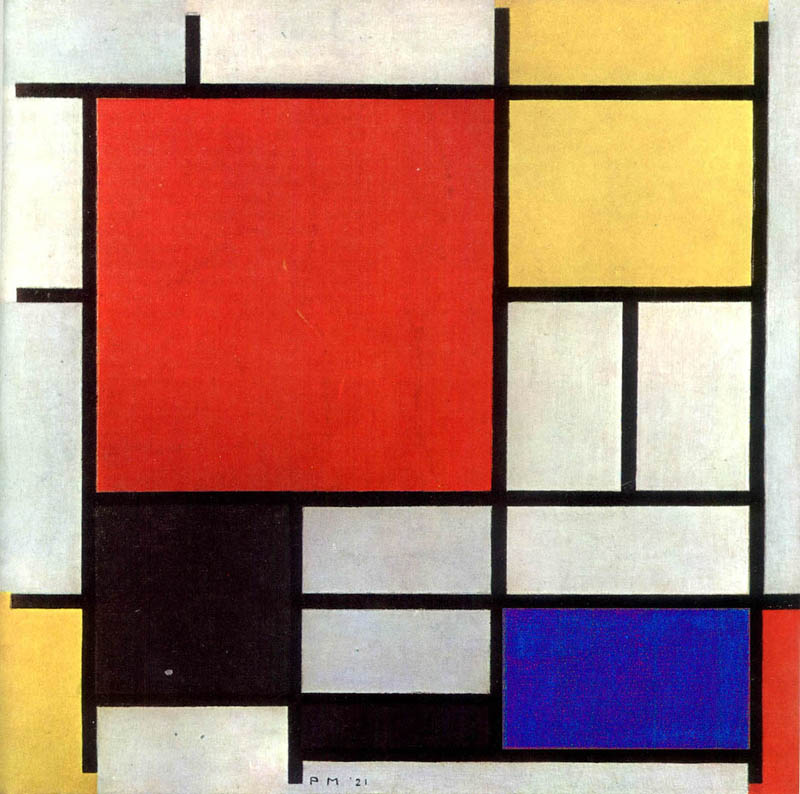
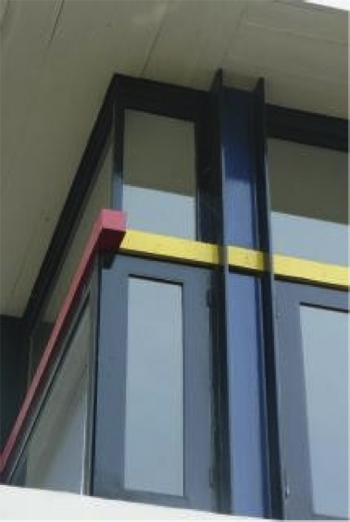
He was influenced by De Stijl’s paintings in the way he choose to paint details in bright red, blue and yellow. The facade was painted in white but with blocks of three different shades of grey to make the surfaces fold back into each other. He decide to have black lintels to make them reflect as little as possible and make them become one with the windows. From a light view the window’s reflect black and in that way he made a stronger connection with the interior and exterior space. The colors is important in my personal impression of the Schröder house. I like that he works with color at the same way as with a three-dimensional surface. He gave me the feeling that he was sculpturing more than painting when he arranged the color on the surfaces.


I got emotionally touched by the Rietveld Schröder House because Rietveld did not work with that house in a traditional way. He was feeling the forms. Just like me when I was working on my chair. I knew something was wrong. I am sure that Rietveld has been staring at a lot of angels and compared a 132 cm long beam with a 135 cm long one, when he was designing the Schröder house. Just like Rietveld I prefer to sketch three-dimensional and I´m thinking a lot about how different form relates to the space and to it self. I think Rietveld shows in the Schröder House that architecture can both work as an art aswell as a design object to which you can react and feel touched, but which is at the same time a functional home. That Rietveld used the elementary forms and had the ability to keep their independence in the new wholeness is what makes this house special to me.


Bauhaus, New Bauhaus, Rietveld


Thursday, April 14, 2011

BAUHAUS, NEW BAUHAUS, RIETVELD

BAUHAUS WEIMAR, DESSAU:
Bauhaus was established as a school for art and design in 1919 by the architect Walter Gropius. The school was originally located in Weimar, Germany but due to conflicts with the National Socialists it was moved to Dessau in 1926 and later to Berlin in 1932, where it was closed in 1933. The Bauhaus was the most influential modernist art school of the 20th century. Bauhaus’s approach to teaching, and understanding art’s relationship to society and technology, had a major impact both in Europe and the United States long after it was closed. The Bauhaus had a profound influence upon developments in all artistic medias such as architecture, graphic design, interior design, industrial design, and typography.

The goal of the artists of Bauhaus was to adjust to the industrial age by creating functional designs. Bauhaus attempted to integrate the artist and the craftsman, to bridge the gap between art and industry and to reunite creativity and manufacturing. Bauhaus emphasized on urbanity, technology and embraced the machine culture of the 20th century. According to Bauhaus the romantic hand making of products in the countryside should be replaced with industrial mass production. The industry demanded a reduction to essentials which meant a removal of former sentimental approaches and visual distractions. Bauhaus was originally a rebellion against the ornamentation and decoration that characterized the architecture, design and art before 1919. Things should now be more simple, functional and honest. With its clear, clean surfaces, rectangular and strict style Bauhaus fits perfectly with contemporary minimalism. Bauhaus was built upon the crafts tradition of England, (Ruskin, Morris) and Germany (Deutsche Werkbund) and concretized thereby a general reaction against the decadent style confusion and upper class ornamentation that characterized the period around the turn of the century.

Walter Gropius wanted a school with a renewed respect for crafts and technique in all artistic media, with an attitude to art and craft once characteristic in the medieval age, before art and manufacturing had drifted far apart. In the school’s early years it was suffering from a romantic medievalism where it pictured itself as a medieval crafts guild without any of the class-distinctions that formerly had raised an arrogant barrier between craftsman and artist. In the mid 1920s Bauhaus School was moved to Dessau and Walter Gropius was replaced by Ludwig Mies van der Rohe in 1930.  The Bauhaus was based on the principles of the 19th-century English designer William Morris and the Arts and Crafts movement that art should meet the needs of society and that no distinction should be made between fine arts and practical crafts (applied arts). It depended on the more forward-looking principles that modern art and architecture must be responsive to the needs and influences of the modern industrial world. Bauhaus was more like a workshop than a teaching institution. It was a “place to built” (Bauhaus) where masters and students after a two-year introductory course worked together in the workshops, where everything from teacups to buildings was crafted using the same principles and by time some of the same idiom.

In the late 1920s, when the Bauhaus in Dessau came under the leadership of the Swiss communist Hannes Meyer the whole school community was informed in a stronger professional and more scientific way. The school’s radicalism and its products were put into a tougher, social context and given a sharper political profile. This provoked the bourgeoisie formalistic and intuitive approach to art and corroded on the political tolerance. As long as the school could be excused as an anarchist hangout for inventive bohemians, it had the right to exist, but as soon as social critic was expressed, the Gestapo would interfere. Despite the fact that Meyer was dismissed in 1930, the school was put into administration and run by the politically far more acceptable Ludwig Mies van der Rohe.

The school is also well known for its faculty, which included artists Wassily Kandinsky, Josef Albers, László Moholy-Nagy, Paul Klee, Oskar Schlemmer and Johannes Itten, architects Walter Gropius and Ludwig Mies van der Rohe, and designer Marcel Breuer.

The motivation behind the creation of Bauhaus came from 19th century’s anxiety about the soulessness of manufacturing and fears about art’s loss of purpose in society. Creativity and manufacturing were drifting apart, and the Bauhaus aimed to unite them once again, rejuvenating design for everyday life. Although the Bauhaus abandoned the sentimentality of the old academic tradition of fine art education, it maintained a stress on intellectual and theoretical pursuits, and linked these to an emphasis on practical skills, crafts and techniques that was more reminiscent of the medieval guild system. Fine art and craftsmanship were put together with the goal of problem-solving for a modern, industrial society. By doing this the Bauhaus school leveled the former hierachy of the arts by now placing crafts on a par with fine arts. With the emphasis on experiment and problem solving the Bauhaus has been enourmously influential for the approaches of arts education in the time after Bauhaus.

NEW BAUHAUS CHICAGO:
As many Bauhaus faculty members immigrated to the United States because of the German national socialist they contributed significantly to the development of North American art, design and architecture. Their ideas were especially well received in Chicago. In 1937 the New Bauhaus design school was founded in Chicago by László Moholy-Nagy who was a former Bauhaus teacher in Germany (1923–1928). Moholy was one of the early masters of The Bauhaus in Weimar and Dessau, but he had to leave in 1933 due to the nazis. The Bauhaus philosophy lived on in the professional work of a few core members who emigrated here among Moholy. Though they left behind their homelands and native cultures they did not leave their convictions and allegiance to Bauhaus principles. The first to take the initiative of continuing the legacy of the original Bauhaus is a group of Chicago business people representing the Association of Arts and Industries. In 1922 the Association of Arts and Industries was established in Chicago to advance the application of good design in industry in order to better compete with European products. The Association hoped to establish a school to train artists and designers to work in industry and some of the members of the Association turned to the Bauhaus as a model of what their school should be. In 1937 the Association had invited Walter Gropius to direct a new design school in Chicago. Since Walter Gropius just had accepted a position with Harvard University, he recommended one of his closest Bauhaus collaborators, László Moholy-Nagy instead. In October 1937 Moholy became director of the school called “The New Bauhaus: American School of Design”. Due to financial problems and other factors the Association of Arts and Industries withdrew their support of the New Bauhaus which had the effect that it did not reopen in the fall of 1938. In February 1939 László Moholy-Nagy opened his own school The School of Design in Chicago. With no support from the Associatioan Moholy was still able to garner the support of faculty and key associates to continue the school Pogram under the name New Bauhaus  – ‘School of Design’. Many of the faculty and students of the New Bauhaus joined the ‘School of Design’ and the school also had the support of former Association of Arts and Industries members, especially Walter P. Paepcke. The School offered day and evening classes, and Saturday morning classes for children. In 1944 the New Bauhaus ‘School of Design’ became the ‘Institute of Design’ which meant a reorganization brought about accreditation of the school and a renewed organizational structure which freed Moholy of the many administrative tasks of running a school. To show the change the old name ‘School of Design’, was replaced by ‘Institute of Design’, and the official typeface was returned to a slightly different version of the font used during The New Bauhaus Era. The school’s academic program consisted of a four-year course requiring all students to take several “foundation” classes depending on their prior education, training, or experience, before selecting an area in which to specialize. Visual Fundamentals, Basic Workshop and Basic Design were among the first challenges encountered by students. Other classes included graphics, shelter design, typography, sculpture, and textile design. Moholy stayed as director of the school until his death in 1946. He was replaced by Serge Chermayeff .  In 1949 the ‘Institute of Design’ became a part of Illinois Institute of Technology during the administration of Henry Heald.  The IIT Institute of Design as it is called today carries the legacy from The New Bauhaus  and offers two professional degrees, the Master of Design (MDes) and the Master of Design Methods (MDM), and a dual MDes / MBA degree program with the IIT Stuart School of Business.

GERRIT RIETVELD ACADEMIE:
The Gerrit RIetveld Academie is a dutch art and design academy based in Amsterdam. The Academy is named in memory of the dutch Architecht and furniture designer gerrit Rietveld. The academy was founded in 1924 after a fusion of three older art academies and acts today as an independent school for higher vocational education. Rietveld has more than nine hundred fifty students of which about 40% come from outside the netherlands.  From 1939 to 1960 the institution was under influence of the functionalism and political views of De Stijl and Bauhaus. This was due to the director Mart Stam who was an architecht with scoialistic political views. In the 1960s Gerrit Rietveld and his Colleagues Joan van Dillen and Johan van Trich Designed a new building for the institute. When Gerrit Rietveld died some years before the the project was carried out and the building was finished the institute decided to honour its builder in 1968 by renaming the academy from Kunstnijverheidsschool to Gerrit Rietveld Academie.

READ MORE IMAGE

Hompje klei


Monday, November 22, 2010

Het startpunt van dit architectuur project was een zelf uitgekozen gebouw van Rietveld, dat interessant was op basis van de relatie tussen binnen en buiten. Mijn oog was gevallen op twee surrealistische gebouwen, die in hun omgeving lijken te zweven.

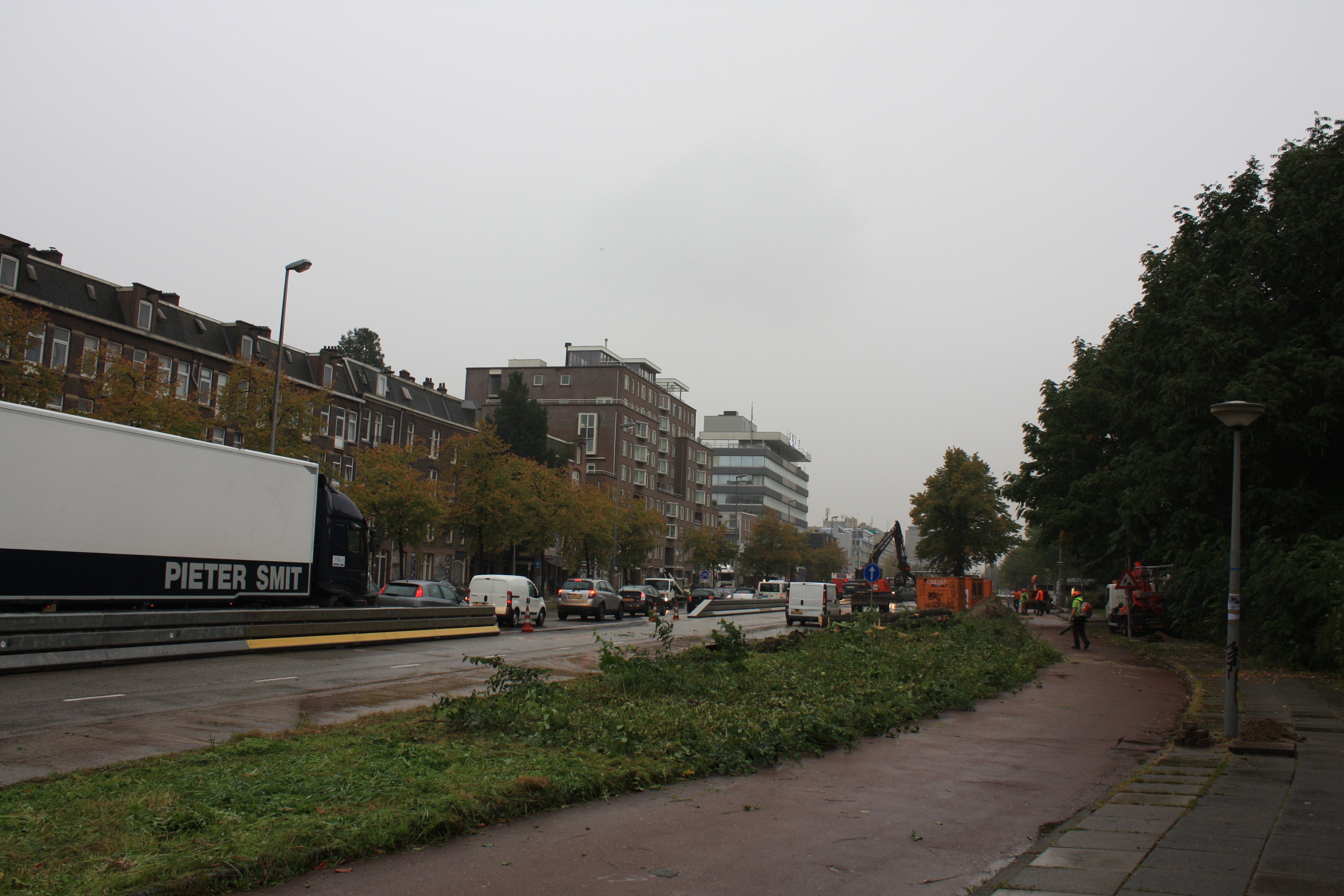
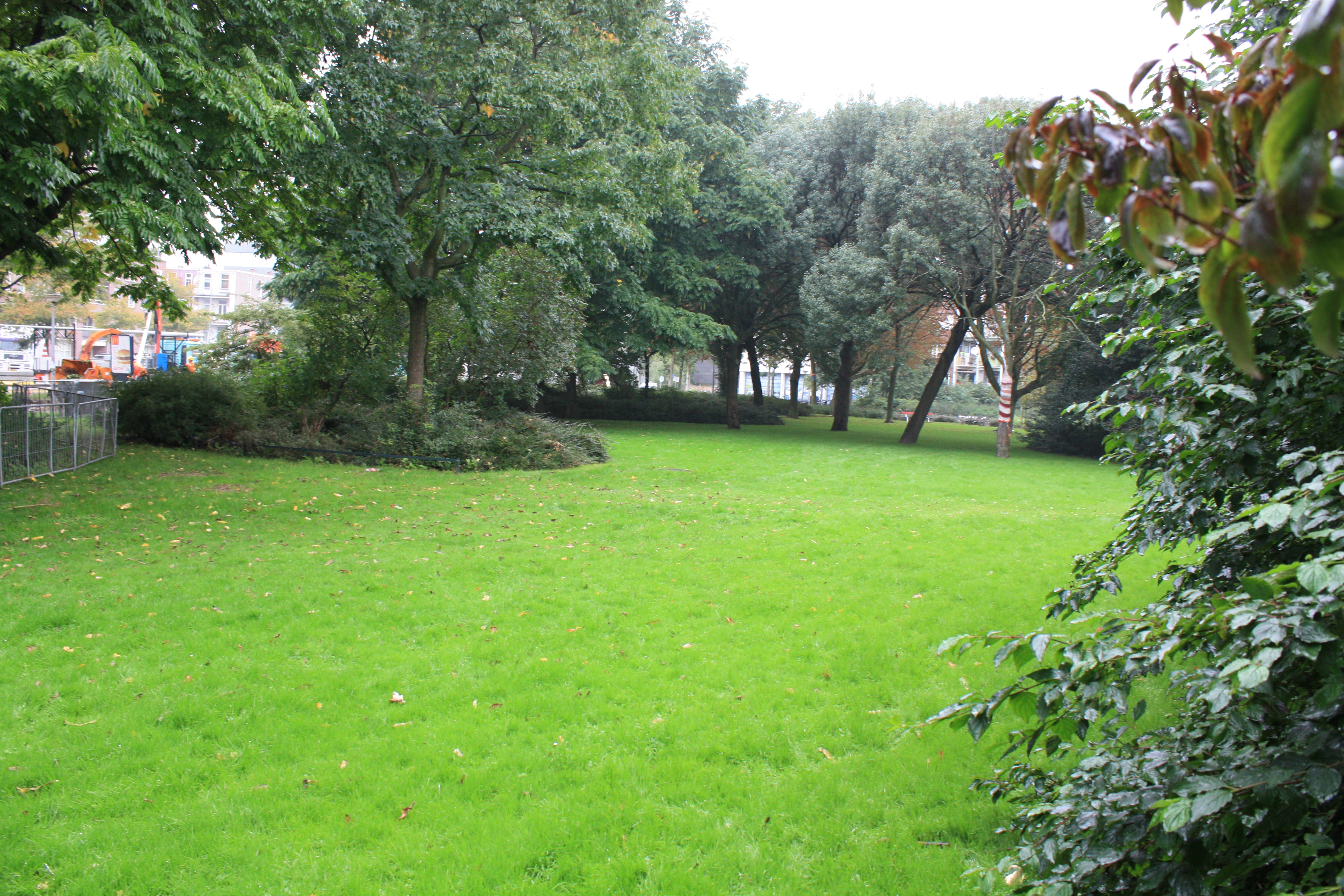
Naar aanleiding van deze gebouwen moesten we een publieke ruimte ontwerpen voor een groen stuk op de Wibautstraat.
Tijdens het bekijken van de plek viel het me op dat de gebouwen op de Wibautstraat totaal niet in relatie staan met elkaar. Het is een onsamenhangend gesloten geheel en de gebouwen dragen niets uit.

Ik kreeg daardoor een beter beeld van welke aspecten ik in mijn gebouw zou willen hebben. Het gebouw moest iets gaan uitdragen, open zijn en surrealistische aspecten hebben. Met deze gedachtes ben ik begonnen aan een reeks kleine sculpturen, al zoekend naar interessante vormen. Uiteindelijk heb ik er daarvan twee gekozen.

De een is speels, verticaal en open. De ander meer  organisch, horizontaal en compact. Ik heb de tweede sculptuur verder meegenomen in mijn proces. Vooral omdat ik de openheid en de speelsheid van deze vorm erg goed vond passen bij mijn doelstellingen en bij hetgeen waar de wibautstraat aan te kort schiet. Maar zodra ik die keuze gemaakt had, liep ik vast en veranderde ik mijn plan in twee krampachtige kubussen op poten, die schuin voorovergebogen waren en die als twee kijkers op de wibautstraat keken. Beide kubussen gaven via de achterzijde een ander uitzicht op de stad. Ik vond de kubussen op zichzelf mooie ontwerpen geworden. Maar het was te statisch en kwam niet overeen met wat ik wilde.

Uiteindelijk heb ik mijn plan omgegooid en ben ik verder gegaan met de organische sculptuur die voor mij veel meer mogelijkheden bood. Misschien paste deze minder bij mijn doelstellingen, maar hij stond dichter bij mij. Ook kon ik met deze vorm naar mijn idee het surrealistische aspect beter verwezenlijken.
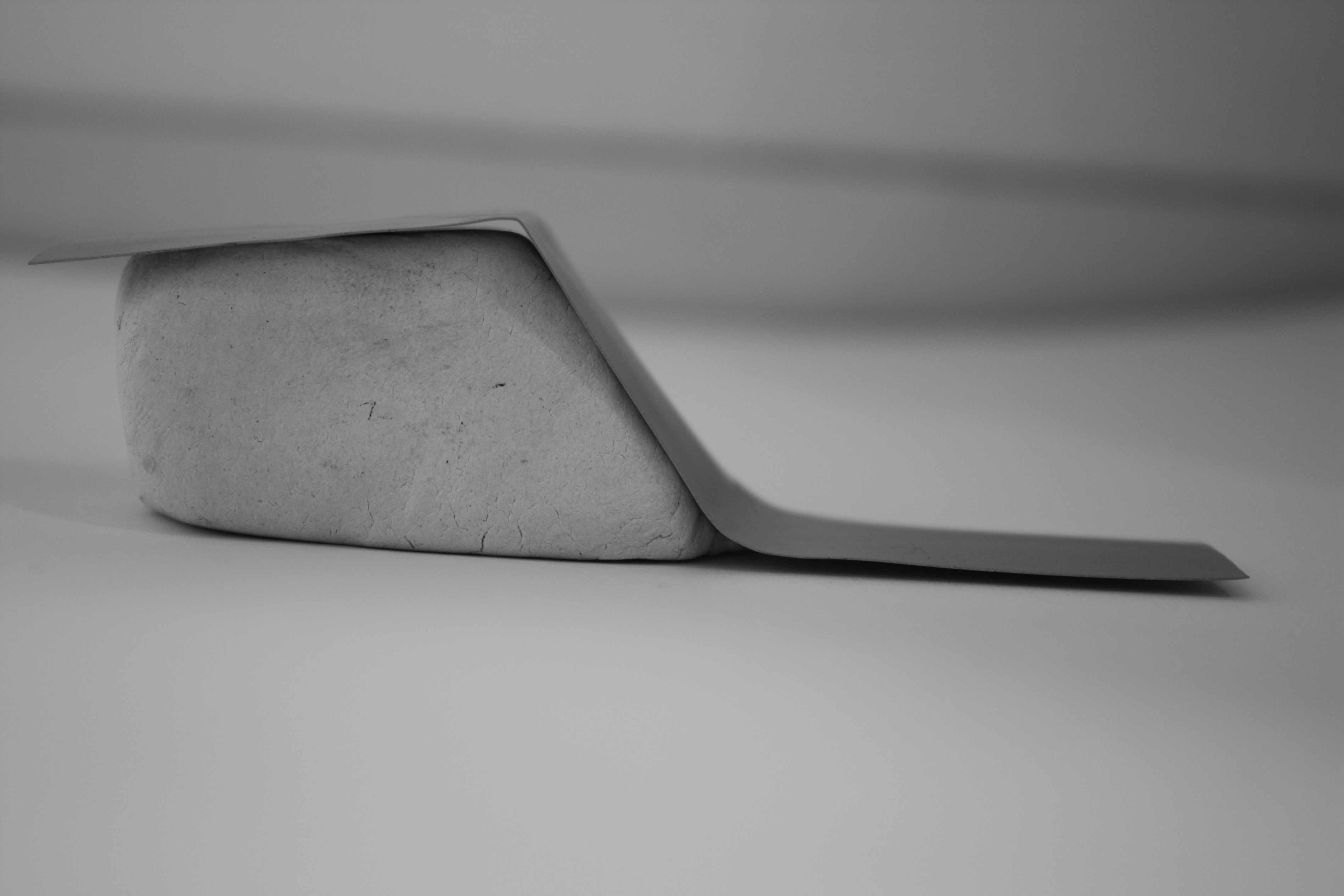
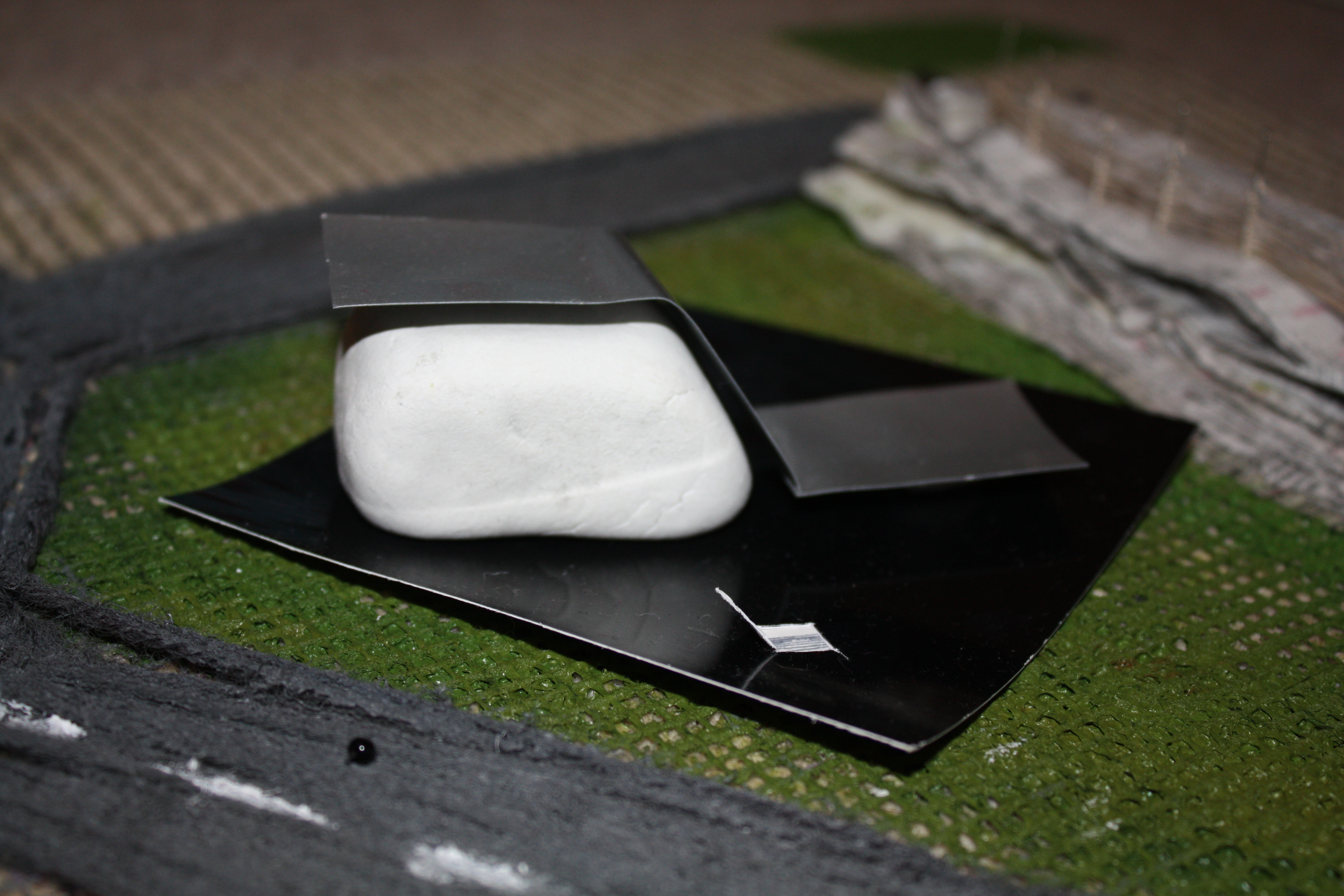
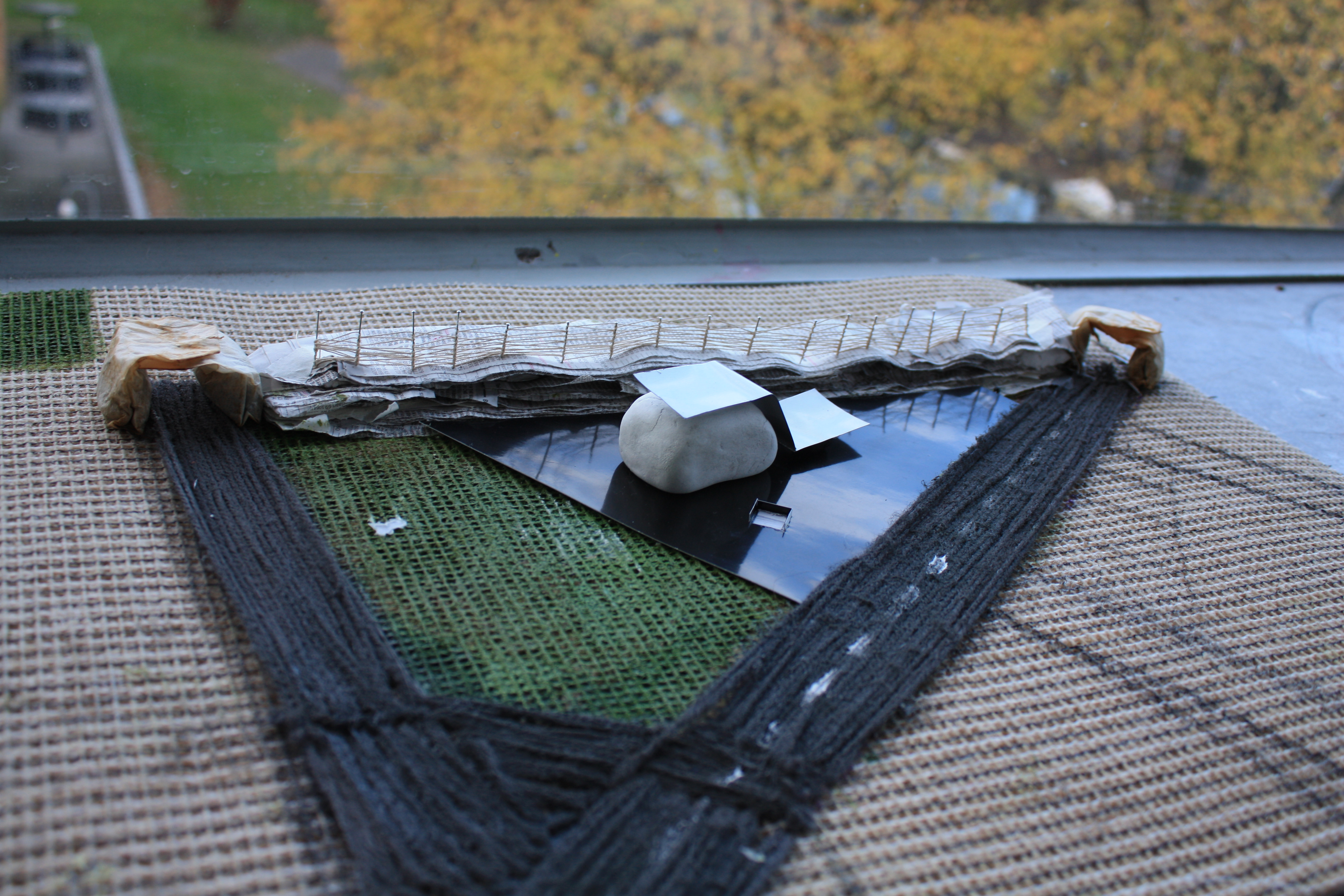
Voor mijn gevoel was ik nu op het moeilijkste punt van het project aangekomen. Het gedetailleerd bekijken en onderzoeken van de vorm. Moest er ruimte zijn tussen de twee materialen en de grond, waar zou de opening komen, moest de organische vorm ronder zijn of hoekiger enzovoort? Na veel uitproberen van verschillende mogelijkheden heb ik gekozen voor een iets rondere vorm en besloten om ruimte tussen de twee materialen te creëren en ook tussen de ijzeren plaat en de ondergrond. Hierdoor ontstonden schaduwvlakken om het gebouw heen die de vorm versterkten en de scherpte van het ijzeren vlak benadrukte.

Om dit aspect beter naar voren te laten komen heb ik een glimmende zwarte plaat onder het gebouw gemaakt waardoor het blok lijkt te zweven omdat er nu schijnbaar ook een schaduwvlak onder het gebouw is en het gebouw daarmee als het ware opgetild wordt.
De vorm van het gebouw wilde ik niet laten beïnvloeden door de opening. Daarom heb ik gekozen voor een ondergrondse ingang. De ingang is even groot als het blok dat als ondersteuning tussen de zwarte ondergrond en de ijzeren plaat zit.

Rietveld App


Sunday, October 31, 2010

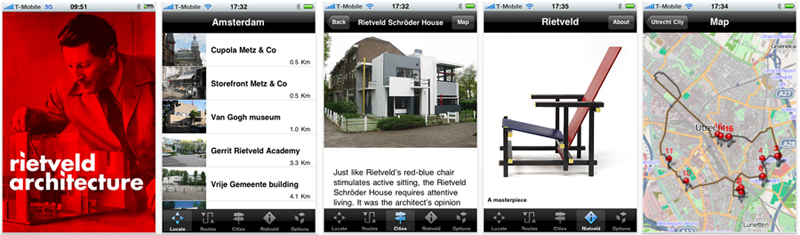
The Rietveld Architecture iPhone application, which people can download via http://itunes.com/apps/rietveld, the App (free, version 1.2, developped by Vincent Verweij ©2010) will help you find all the Rietveld buildings and houses in the Netherlands that still exist.

The Centraal Museum has launched the Rietveld collection online. Visitors of the website will find more than 8000 objects by Gerrit Rietveld (1888-1964) kept by the Centraal Museum. The objects in question consist of mostly 8000 archive items and almost 300 museum objects, most of which furniture. Many people are familiar with the red-blue chair and the Rietveld Schröder House, but Rietveld designed many more pieces of furniture and houses. The website collectie.rietveldjaar.nl provides a complete overview of Rietveld’s entire oeuvre. It is quite unique that such a large part of a designer’s work has been retrieved.
The online Rietveld collection http://collectie.rietveldjaar.nl/ consists of almost 300 museum objects from the collection of the Centraal Museum and approximately 8000 archive items. The latter are owned by the Foundation Rietveld Schröder Archive and have been held by the Centraal Museum since 1985. The Rietveld Schröder Archive is the archive which was kept up to date by Truus Schröder at the Rietveld Schröder House in Utrecht. It consists of huge architectural drawings to personal scribbles on business cards.

Rietveld versus Calatrava


Saturday, October 30, 2010

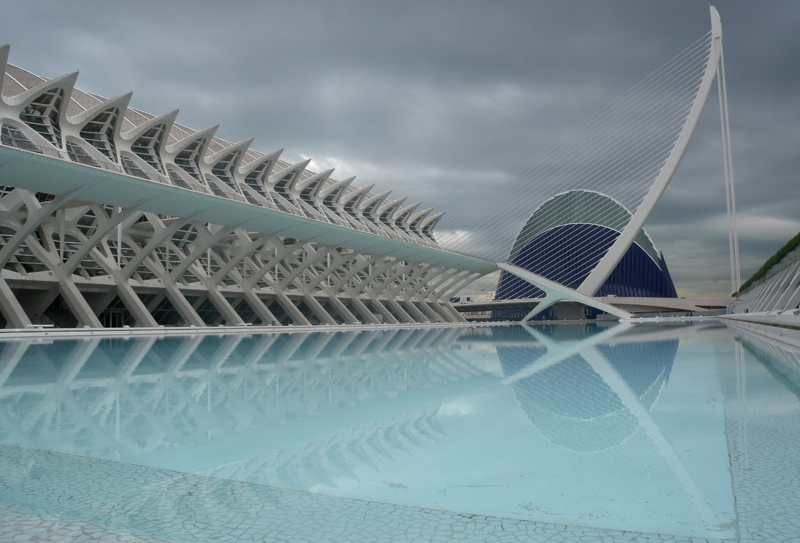
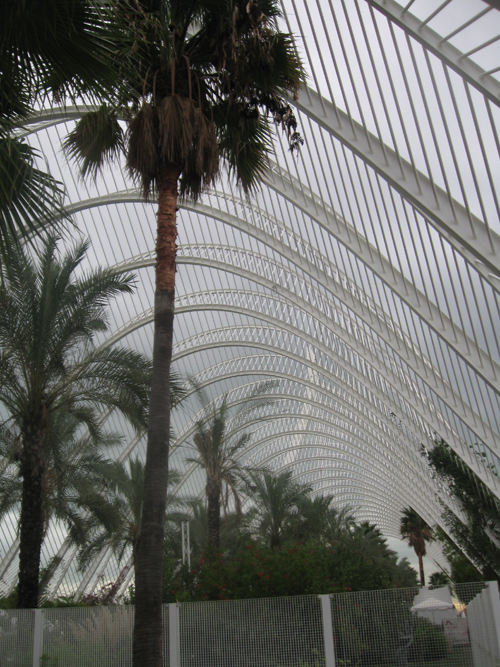
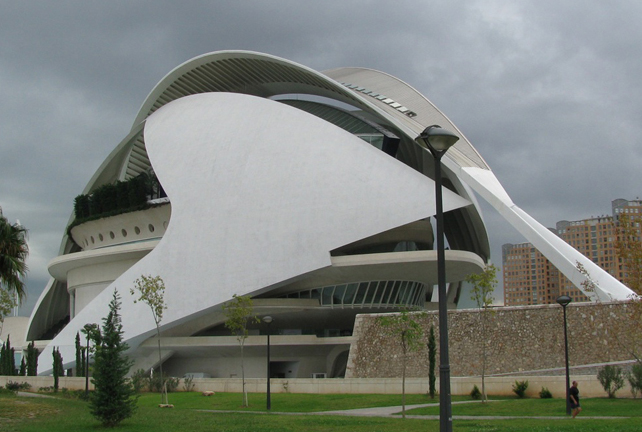
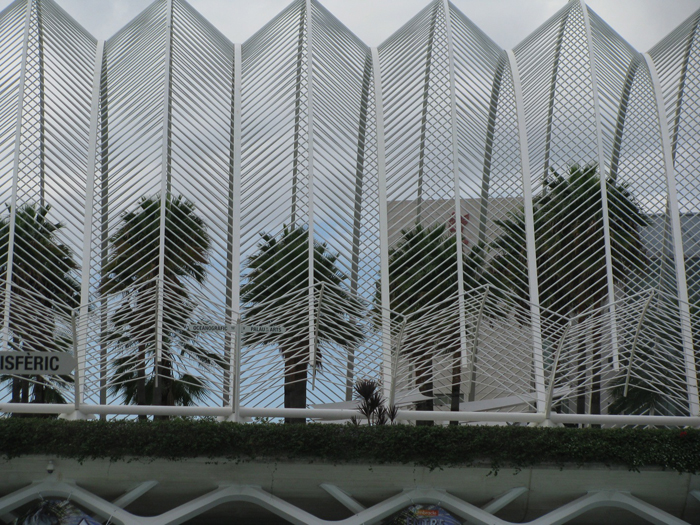
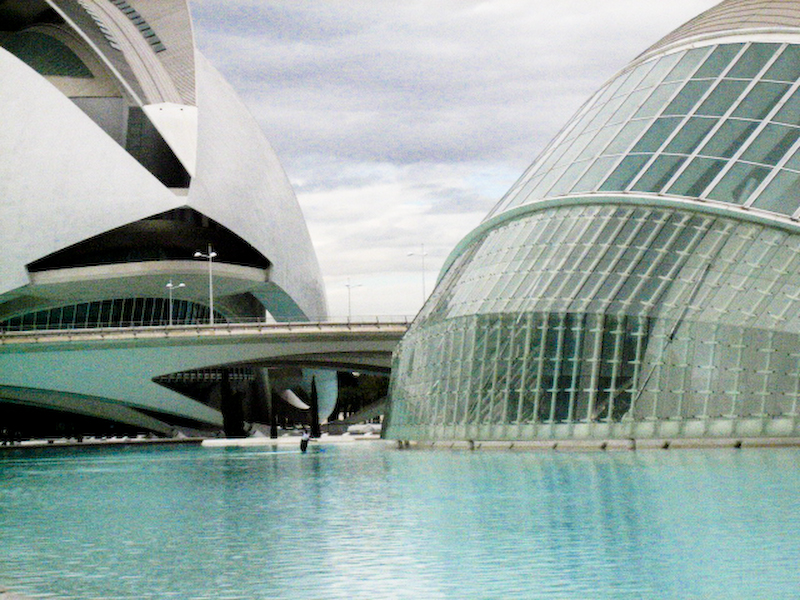
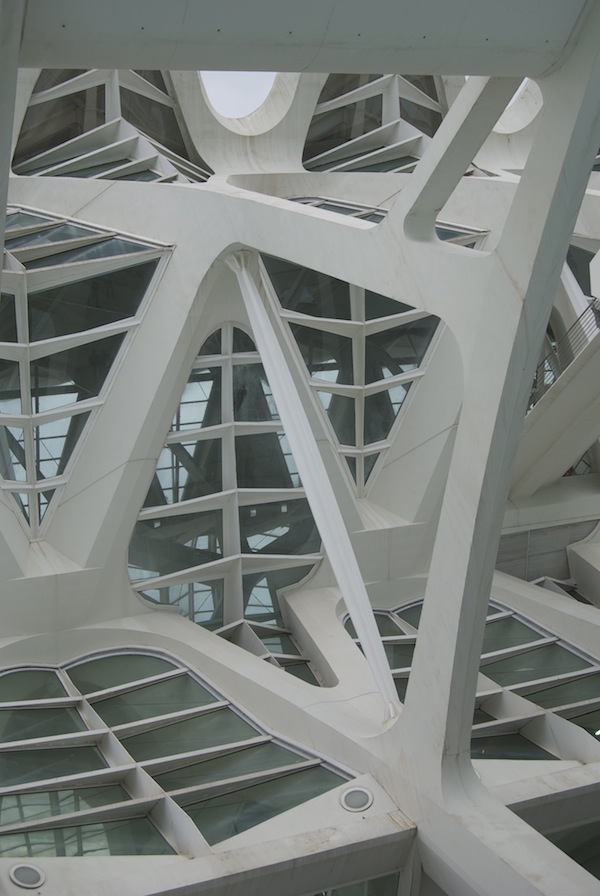
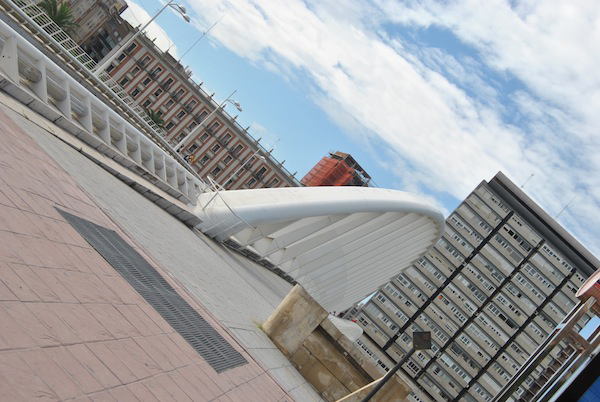
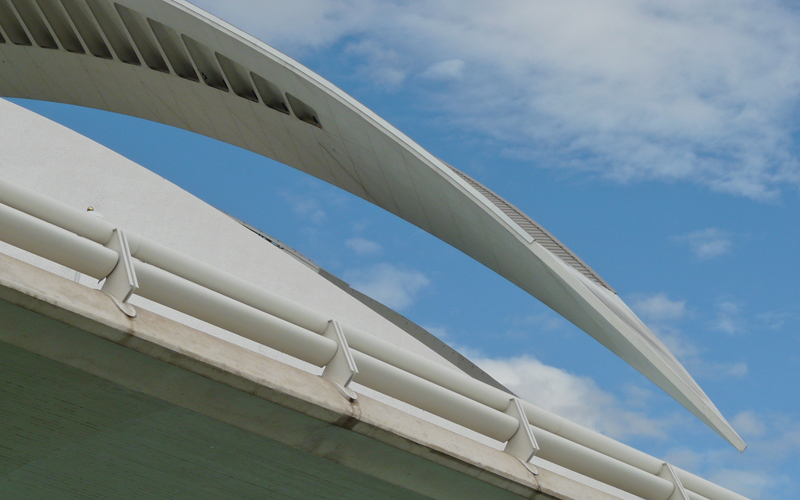
Exploring Valencia (Spain) as a prologue to Manifesta8, most students of the Basic Year visited "The City of Arts & Sciences" designed by Santiago Calatrava. As inhabitants of The Gerrit Rietveld Academie designed by, and named after Gerrit Rietveld himself, a comparison became inevitable. What follows are their comments and images.

[comment by Alexandra Karpilovski]

Calatrava feels like something not for you and not for me, but for someone whom we do not see. It makes me feel small, but also nothing.
It makes me think of a monument over the times that has passed, something sculptural and grand and made to impress but fails in that and becomes something static and untouchable. That a buildng that takes up so much space is mostly used to see and not to be touched.
The difference between Calatrava and Rietveld is like comparing two different worlds. For me Rietveld represents a calm structure, everything fits effortless and live in symbiosis with each other, the whole mind behind the building is put into place, on the exact spot where they should be, the body of the houses is on the inside, while Calatrava on the other hand just goes manic and drags different forms into space, just to make it look interesting.
Calatrava makes me feel that someone is trying to say something, but of course I don´t understand, it is to big for me.

[comment by Michael Hautmulle]
Both Calatrava and Rietveld are known for the details in their work, and it shows in both their work. The way in which they both apply it is very different however, where Rietveld has designed beautiful buildings, they are beautifull because of their practicality, so that every detail is constructed to make the use of the building more clear and make the life and function of the occupant more clear. Calatrava has a very different approach, he uses details purely on an esthetic basis, his building may not be very practical, I do not say whether or not they are beautiful, that is an individual matter, but every centimeter has been specifically designed to create the image that he desires. Again I do not wish to say much on the matter of esthetics, but I do believe that the most beautiful design is that which serves a purpose, not for idle beauty but as an object, or building, that fulfills its purpose well. That is the most beautiful of all.

[comment by Titia Hoogendoorn]

While Calatrava’s architecture could be seen as a sculpture and sometimes almost as decoration for the surroundings, Rietveld’s buildings are anti-decorative and more an expression of architecture. They both include the environment in their works. One by fitting in (Calatrava) and the other by adding (Rietveld). The shapes and colours of Calatrava's buildings are flowing along with nature (blue and white/sea and air) in comparison to Rietveld who devides space accentuated by primary colours. The architectonic skeleton of his buildings coincide with the construction while the skeletons of Calatrava seem an effort to make them visible on the outside.

[comment by Anna Kinderman]


Inspired by organic beings Calatrava forms futuristic, abstract entities, which he covers with diverse details and additional figures. Many details are purely visual and omit practical ulterior motives. However, he is limiting to discreet colors like white, blue and azure. Inspirations: torso, bull ribs, foliage, wings. His buildings are more like sculptures than functional buildings.
In contrast Rietveld is interested in function. He was inspired directly by the materials and dealt with the use of the building. With the reduction of coloring to the primary
colors like red, yellow, blue, black and grey he wanted to emphasize the different layers/planes. His strict geometry and minimalistic tendency distinguishes him from Calatrava like black from white.

[comment by Lovie Peoples]

Rietveld and Calatrava are two totally different architectures to me, both in the way their buildings look and the feeling they mediate.


Calatravas buildings are like sculpture houses and bridges. Fixed artworks that was created to demonstrate what he wishes to show. His imaginations illustrated on the ground in a space. To me it doesn’t leave that much to my imagination you are in his world. Either you like it or you don’t.
Rietveld houses have an obvious presence, melting in to their environment instead of creating an environment totally in them self. Which makes them a part of it and lifts them up. They make a dialoged to the space around it and invite me to feel at ease with my own thoughts and feelings in them. A meeting point in what he has left as a building and the person in them. An open dialogue with the viewer.

[comment by Molnar Tamas]

The two architects represent opposite design philosophies and approaches to man and its created environment. While Rietveld takes man and its size as starting point and adjust details to this, Calatrava creates vast spaces and buildings to impress the viewer, making man’s size unimportant. The Spanish exaggerated “machosim” meets the cool and minimalist Dutch world. Experience vs. functionality.

However, both of them are lacking in cosiness, Rietveld’s sharp edges and grey colours are rather cold and not welcoming. Calatrava uses the huge size of his buildings to alienate the spectators, making them feel being in a church or at some futuristic place. His typical white colour also contributes to the sacred, church-like sensation, where one should feel devotion and its own littleness. The usage of forms is also different. Rietveld introduces forms derived from the cube, the “box”, making and industrial and artificial look. Calatrava prefers the organic shapes, however, those are clearly computer generated “natural” forms put in order which finally results in the experience of an artificial environment just like in the case of Rietveld.

[comment by Pieter Tensen]

Calatrava designs buildings you can hardly call buildings. They are more like sculptures you can visit.  This is something you really notice from the outside and is a major point where Calatrava confronts Rietveld in his designs. Rietveld cared about the outside of a building too, how it looks, but it appears obvious in that way.

In Rietveld’s buildings everything is build up out of 90 degrees corners. This was his main trademark. Natural shapes and the human body, on the other hand, inspires Calatrava. They have one major thing in comment. They both care a lot about details. Although the buildings they designed we’re big and impressive sometimes, the eye for detail is very specific for both.

[comment by Stefan Voets]

“Rietveld adored light and bright spaces without too much detail. This is why most of his buildings are made of primary colours and forms (squares, rectangles). According to Rietveld, a building has to be functional too (functionality is extremely present in his architecture). Calatrava’s work is differently shaped, because of the massive surfaces and the lesser subtility. The material is heavy-looking.”

Growth


Saturday, October 30, 2010

[comment by Joost van Loon]

Get the Flash Player to see this player.

It was an impossible but nice fantasy. Gerrit Rietveld and Santiago Calatrava were strolling side by side between the Hemisfèric and the Palau de les Arts. Looking at The City of Arts and Sciences. Gerrit Rietveld, hands on his back, gazed up at the highest peaks of the Palau and nodded his head.
“So.” Calatrava opened up the conversation. “ What do you think of my building?”
“It’s big.” Rietveld replied.”
“I know.” said Santiago puzzled. “But it grew naturally , almost like an independent living organism.”
“Really?”  Rietveld was lost in thoughts for a moment. “A smaller building can also be grand and then the people inside will do the growing.”
Calatrava looked at Rietveld in shock, but Rietveld didn’t noticed and continued. “Maybe you could add some colors?”
Now Santiago stopped walking, too perplexed to carry on.
The man that should be in heaven wandered on alone. Looking at the buildings he mused to himself . “Yes, some red and blue would be nice.”

Rietveld grey and Mediterranean blue


Saturday, October 30, 2010

[comment by Lyubov Matyunina]

In our life we often compare different meanings and objects. Peoples, animals, jobs, close, building – everything becomes a point of comparison. If we look at 2 buildings, what do we see? Many differences and some similar things. Let’s compare The Rietveld Academy and Calatrava's City of Art and Sciences on 4 points: Age, Function, Design and Practical use.

Age

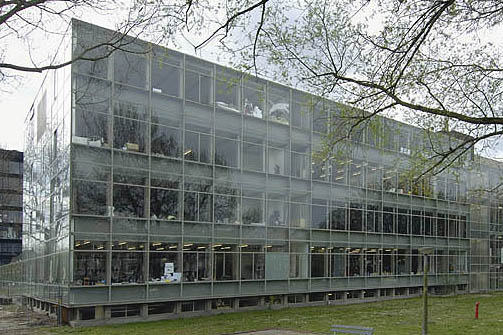
The Rietveld Academie consists of two buildings: The main building was designed by Gerrit Rietveld between 1950 and 1963 and was finished in 1966. The new wing, designed by Benthem Crouwel Architects and built in 2003, is used by the fine arts departments. In our comparison, we will compare the main building, designed by Gerrit Rietveld.

The City of Arts and Sciences designed by Santiago Calatrava and Félix Candela, the project underwent the first stages of construction in July, 1996 and the finished "city" was inaugurated April 16, 1998 with the opening of L'Hemisfèric. The last great component of the City of the Arts and the Sciences, El Palau de les Arts Reina Sofía, was presented at October 9, 2005, Valencia's Community Day.

As we can see, Rietveld is older then Calatrava by 30 years. But both of their buildings looked modern for the time in which they were built. Actually, Calatrava City of Art & Sciences still looks modern and futuristic, while Rietveld design start to be popular and today we can see buildings inspired by Gerrit Rietveld.

(more...)

creating a performance


Saturday, October 30, 2010

[comment by Julia Estevao]

Calatrava /surrealistische sfeer
dit komt door de stilte, het water, de witte kleur van het ontwerp zelf in contrast met de donkere omgeving (bomen bijv.)en grijzige lucht, (grove, grootse) vormen, (grote) formaat. het doet denken aan een verlaten pretpark.
de mannen die het water schoonmaken, lijken een performance te geven; heel rustig lopen ze heen en weer.


Rietveld /
het enige door Gerrit Rietveld ontworpen gebouw, dat ik met eigen ogen heb gezien is de Gerrit Rietveld Academie.
wat me daaraan opgevallen is zijn de verschillende materialen; puur, grof en fijn, passend bij elkaar en lijnen, smal en breed. Fijn en eleganter, door de materialen en vormen. Het geheel oogt strak en simpel en is heel erg open. Ruimte om te creëren.

Een gevoel van openheid.

Design Trip to Insel Hombroich


Sunday, December 2, 2007

Haus Esters Haus Lange Mies van der Rohe

The Design Trip to Germany took us to Insel Hombroich in Neuss Germany. On the way we stopped at the Museums Haus Esters and Haus Lange, Mies van der Rohe’s first building experiments (1929) with -non supportive- brick housing. The buildings were clearly designed to look from inside out as we experienced while exploring the art and photography filled interiors. Especially the bathroom on the second floor gave us a sweet glimps in the past.[above: Thomas Ruff /under: Haus Lange by Mies van der Rohe]

Haus Esters Haus Lange Mies van der RoheHaus Esters Haus Lange Mies van der RoheVenician Glass Hombroich craftsRietveld Hombroich

During a beautifull autumn day, we entered the magical Erwin Heerich‘s Pavilions followed by red and yellow leaves . Nowhere can daylight be experienced like this, looking at the art and craft as it realy is and was meant to be. The unique melting of architecture, art and craft can be enjoyed only at a few places like this. Calder, Yves Klein, Buddha, China or Schwitters and Bart vd Leck, the shere power of it made us enjoy this humbling moment. Architectura et Natura[above: Venician glass / Gerrit Rietveld furniture

G group’s research subjects


Sunday, November 11, 2007

le poeme de l’angle droit corbusierbrasilia Oscar Niemeyer

Based on the general theme “Le Corbusier and Other Stories” we investigated a variety of subjects related to the content presented at this summers Corbusier Art and Architecture exhibit at NAi, Rotterdam. Research material was edited down to A4 sized guided tours into these subjects. All subjects presented in this list are available as hard copy prints at the Research Folders at the library:Primitivism, Le Poème de l’Angle Droit, Corbusier’s Christmas Gift, La Chapel de Notre Dame, Amedee Ozenfant, Corbusier in Istanbul, Varese’s Poème Electronique, The Candigarth Project, Modular, Language of Organic Form, Corbusier and Politics, The Bric, Ferdinand Léger, The Brasilia Project, Sandberg’s Experimenta Typografica 11, Koolhaas/Lagos, Nature Design Zurich, Constant’s New Babylon, Rietveld’s Academies, The Chaisse Longue


Log in