Skip to Content Skip to Search Go to Top Navigation Go to Side Menu


"instalations" Category


The making of Medium Girl


Wednesday, November 18, 2009

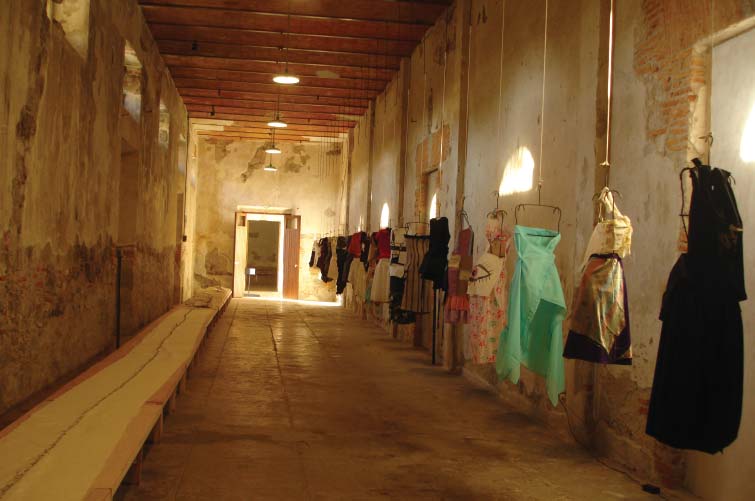
When DHL delivered the package with the traditional Zeeuws costume to the Bristol Hotel in Athens, Greece, I immediately ripped it open, only to find a stack of different fabrics in various sizes, textures and colours.
I had no idea what to do with these mostly two-dimensional pieces of cloth, what was supposed to go where and how.
This knowledge-gap became the works’ major point: what is the perception of a traditional cultural expression by someone from another country (and in this case I regard the city of Amsterdam as another country in relation to Zeeland as well) grown up in an era where self-examination and focusing on the present and future prevailed over historical awareness and/ or cultural pride.

Get the Flash Player to see this player.

In short: a young Danish woman of gigantic proportions who happened to pass by on the streets of Athens was lured into the hotel room, to be dressed and undressed in different combinations by an innocent Greek woman, using the separate elements of the costume to create a whole new image of national identity.

Barbara Visser, Winner of the Dr A.H. Heineken Prize for Art (2008) check out her new website.

Medium Girl (1996)
video, 6 x 30′

The perfect workspace, does it work?


Thursday, October 15, 2009

I find it really interesting to visit an exhibition were artists are working. It gives you a look into the thoughts of these artists. You can see the process.

“Published Workspaces”, I called them in my research.

Published Workspaces make people think, they activate the people’s creative minds. And I think that is a good thing.

In these Workspaces you are often involved in the work process, sometimes you can even help the artist.

In my research I am wondering about the intention of these Published Workspaces, and if they achieve their goals.

Published_Workspaces

We are all constructs -made up of mythologies we build ourselfs


Thursday, October 15, 2009

The dutch company VLISCO is producing batik fabrics all of us immediately regard as authentic african. Researching on this one is forced to concern oneself with the peculiar situation of interweaved, imposed and inherited cultural identities.

How does it fit to our stereotype that this fabric, which became such a strong symbol for the celebration of postcolonial independency is actually designd by the dutch? The path opened by this little question leads far. Where do our strereotypes come from? To which extent is cultur original? What do we build our identities out of? What do we regard as typical african, what as european? How do we deal in the postcolonial age with our guilt for colonial crimes?
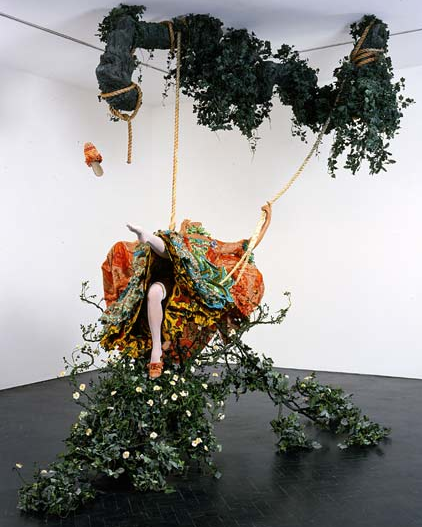
My research is in particular focusing on „the swing“ made by the british-nigerian artist Yinka Shonibare, who is using the dutch wax as a kind of trademark in his work and somehow seems to be related to all questions mentioned above.

yinka_shonibare

slowLinking: tagging slow design part 3


Monday, May 4, 2009

Welcome to part 3 of : tagging slow design. This is a worksheet on which all the link-topics and post-it tags collected on the “slowWall” are listed in relation to the research subjects as components of the ’slow design project’. (researches can be downloaded as .pdf’s).

link topics.

Performance links the Morgan O’Hara research to the one on Julia Mandle. The Julia Mandle research links to the one on Richard Long on the topic street /nature & art, by slow movement to the Kunsthalle Bern exhibit and by sensibility & violence to the Psychogeography research. Psychogeography has the link topic urban life with the Karmen Franinovic research, consumption /destruction /life style with Futurisme, against and pro community with Wim Wenders, evolution of everyday life to Downshifting, and a anonimous link to Maria Blaisse. This anonimous link is not the only one linking Marie Blaisse. Link topics like art and left over, connect this research to Uta Barth. Karmen Franinovic links to Christian Nold by means of the topic mapping, and to Psychogeography by urban life, to Futurisme by life is getting faster & people are getting a social, to Julia Mandle by just stop & think and to Richard Long by the link a way to see. Richard Long links to many other researches: to Sophie Calle by self related art, to Christian Nold through a line made by walking, to Karmen Franinovic linked by the topic a way to see, to Downshifting by choosing slowness. Downshifting links back to Julia Mendle by the link topic us and them, to Psychogeography by revolution of everyday life, to Futurisme tagging the link with designed lifestyle, to Marie Blaisse by us and them, and to the Kunsthalle Bern exhibit by reflect /a closer look. The research on Futurism has some remaining links to Julia Mandle through the topic exploring / explosive / sculptural. Following links from Wim Wenders to Uta Barth is made possible by the topic notice the small things in life, to Christian Nold by moving /memories. Mapping links Christian Nold to the Ambient/Brain Eno research while that last one makes a link back to the Kunsthalle “The Half and the Whole” exhibit creating a take time to cook link.

Reading all the researches the links will surely start to make sense, as will their variety shed light on the specific nature of many of them. Some research subject however did not create any link at all, like in the case of Maison Martin Margiela. And it was 0nly after some discusion that the performance link was created between Sophie Calle and Karmen Franinovic. Uta Barth was anonimously linked to Richard Long which might have been an intuitively act

Post-it tags.

No links did not mean no tags. Time, Maison Martin Margiela for example was closely read and tagged with post-it. This created tags like memories, replica, time(less), can’t relate to it, time, physical picture of memory and the photographical tag to a picture by Mark Manders. Wim Wenders (present in our research list because of his beautifull documentary “Notebook on Cities & Clothes” about fashion designer Yohji Yamamoto) generated also many tags like sublime, I finally found time, hillbilly, surreal, the truth, place, moving. Sophie Calle tagged by the moderator with authorship, generated: life=art, stories, documenting life. Uta Barth looking was tagged: rainy day with half closed eyes, in between places, no left over, sunday. Ambient the research connected to Brian Eno tagged as big here long now was retagged as live the moment, loosing yourself, don’t think, sound. Christian Nold place-ness got tagged with keywords like biomapping, google earth, links, remapping memories. Linked to many, tagged by few. Julian Mandle pause, was tagged with pause from urban flow only. Morgan O’Hara gestures was tagged with trans, transforming, concert-art, transmission, energy of moments, reaction. Maria Blaisse architecture by border between self and not self. Futurism with fast life, life style, save time? Downshifting was tagged with life style too and change assumption. Richard Long tagged as a subject with landscape was enriched with the two tags: exploring fast and slow and perception of space, time and personal potency. Psychogeography with destruction of community, philosophy, socialism, anarchisme and urban live. Finally Karmen Franinovic subtraction, served as a hub for the tags: observe, spontaneous landscape, discover a realy nice place that never be online, easy fast, MTV generation, reflect, and observe. Some researches like Conditional Design re-mapping did not make “the slowWall” and were concequently not linked

added tags from the slow design lecture.

scale, gestures, measurements, relations, sustainability, evolving, creative activism, reveal, expanding awareness, reflect, engage, participal, deceleration, fresh connections, rhythm, probing, (im)materiality, metabolism, reflective consumption, live span, memories, community, record, tracing, (human) body, break (take a break), nothingness, inclusive, transparent, re-mapping, connection to scale

read also: >tagging slowdesign part 1

What’s In A Name: a Project for Gray Magazine


Saturday, April 18, 2009

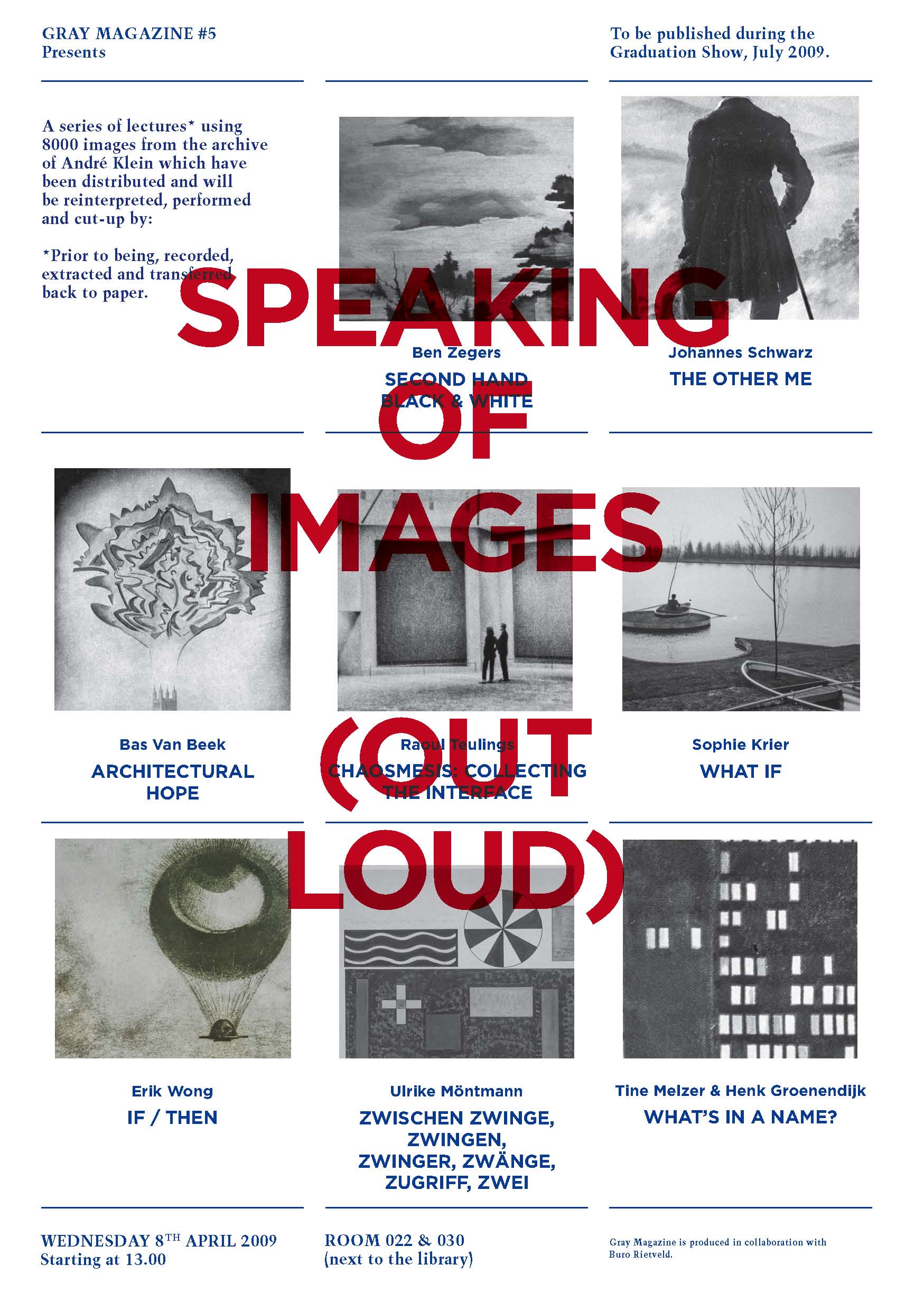
On request of Gray Magazine (yearly published on the occasion of Rietveld’s final exams show) 40 students of the Foundation Year, guided by Henk Groenendijk and Tine Melzer, unleashed a two day project to create a new context for a highly varied 20.000 slide images archive. André Klein, now chair of Fine Arts and Sandberg Applied Art Dept, compiled these slides over his 25 year long career of art history teaching.

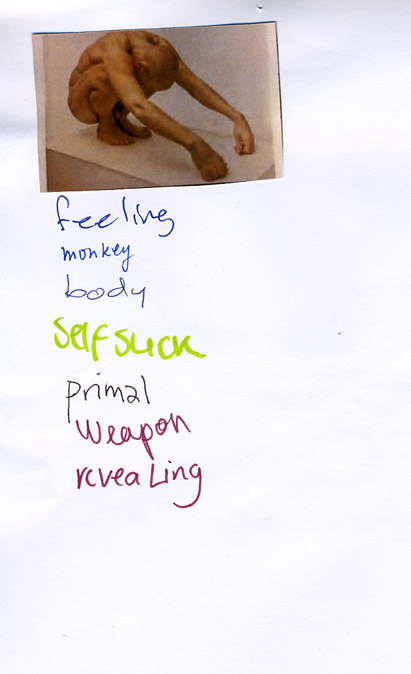
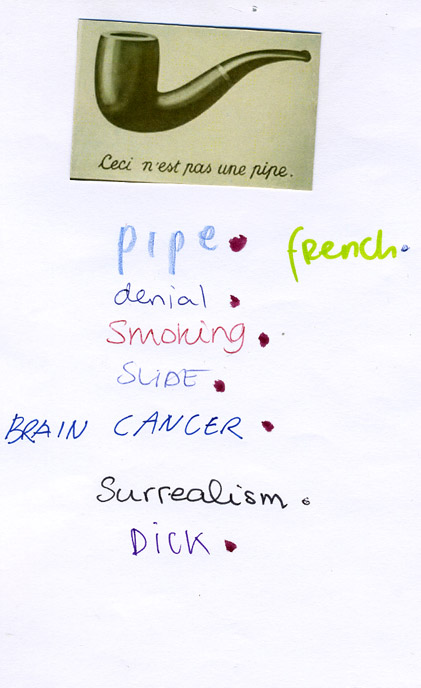
We could only guess after the motives and meanings that bound these images together in a dynamic process of ever changing contexts and wonder what new context of relation they would have in the eyes and minds of the basicyear students. The uninhibited existence of a ‘democratically’ selected 1000 reproductions, registrations and images was given new meaning through a process of retagging with subjective keywords. In the 2 day process new contexts and connections were created, processes where discovered, and results presented in a physical display of image related tag-lists and monumental alphabetical (key)word lists. I am a kid
I burn
ice
ice cube
iceberg
ice cream
Iceland
ideal
IKEA
ill
illusion
Illustration
image
imagination
immigration
imitate
imitation
immaterial
impale
imperfection
impossible
impression
in scene
incest
inconvenient
increasing
identical
India
India
Indian
industrial
industry
infinity
influence
information
ink
inner space
innocence
inquiry
insane
insect
insecure
inside
insides
installation
institute
instruction
instruments
integrate
intellectual
intense
interaction
intercourse
interest
interference
intergalactic
interior
intertwine
intimacy
intruder
invasion
invention
invisible
invitation
irresponsible
island
isolation
it
Italy
itch

Awareness surfaced about the relation between content and image and word and form and content in the contexts of our own terms. Tagging images uncovered these relations

some of the question we asked ourselves were:

The mechanisms of images and imagination on one side and the mechanisms of names and naming on the other – where do they both meet?
What is the link between what we see and how we call it?
What is the process of agreement with the other(s) to find relevant and appropriate names?
Is tagging also a kind of ‘baptizing’? Or rather an act of memory and memorizing, how things are called?
What is the level of interpretation when we have to give an image a tag?
What is the relationship between tag and image, word and view?

For more information on this and other project based on the same archive, read Gray Magazine 2009.

Bruce Nauman, but not on citizenship.


Wednesday, April 1, 2009

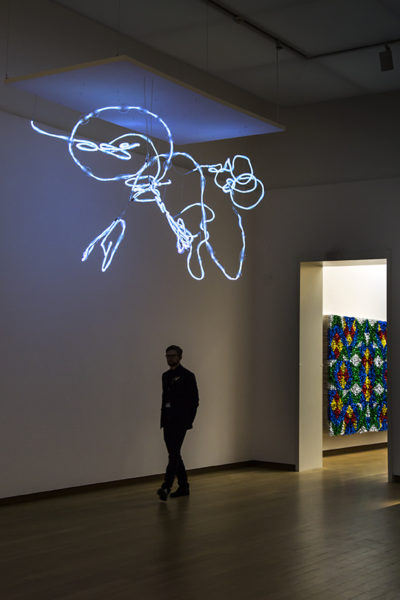
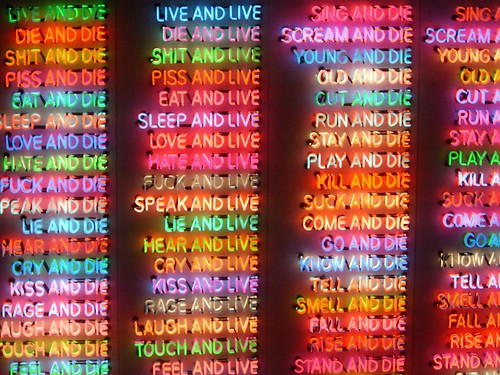
As a final post on flaneurship and neon lights in the city landscape, I chose to write about  Bruce Nauman. This might seem confusing, because his works are usually displayed in a gallery or a museum, quite isolated from the busy city environment that was my starting point for the first post.

Nauman made some installations with neon light, some containing text, others consist of images only. I chose these three examples from the mid-eighties (One Hundred Live and Die, 1984, Seven Figures, 1984, Mean Clown Welcome, 1985) for the more or less brutal messages they communicate.  I still don’t know what the medium neon in itself expresses. This needs a more elaborate research. I’ll try to give a short comparison between Nauman’s work and the neons in Vegas. Comparing these two types of neon signs arise questions about this romanticist (yet uncanny) idea of a flaneur who gets sucked into a dreamworld of lights in the city. The common divider between these works of Nauman and for instance the neon signs in Las Vegas is immediacy. Both types of signs are attacking the viewer, but the effects are parallel reversed to one another. Nauman plays with a system of repulsion, while in a competitive commercial context (such as Las Vegas), neon signs would rather be used to evoke attraction. Still, I think both have to do with desire.

cat.no. -naum-8

keyword: neon

Humans


Wednesday, April 1, 2009

we are humans…

humans who are creating…

creation is an human action…

humans who are destructing…

destruction is an human action…

creation and destruction

thats human, thats us…

-twom- I

keyword: playground

is it a sandwich? what is it?


Wednesday, April 1, 2009

“Vorm van sculptuur” is on mine opinion a sculpture about sculptress like Marenne Welten, Anne Auloos, Inge van ‘t Klooster, Mia Trompenaars , Melanie de Vroom and Marenne Welten.
It’s a collection of small books form each artist.
Based on what i am seeing from the inside and outside of these small books,
i would say that they are showing fragments, details, sketches of the works.

The most interesting picture of the work of Anne Ausloos is for me one of her paper works from 2009. The reason why this photograph is so interesting to me, is because it brings questions and the form is funny.
what does the object represent? is it solid, is it edible, is it a sandwich?

if i talk about Inge van t’ Klooster i am talking about the most not attractive works of the whole group. i am basing this sentence on my taste and not on the quality of the work. the reason why i don’t find it attractive is because the massiveness and the darkness of the work. The Virtual work that she made with Martin Riebeek called “Between you&me” is interesting to me because it’s an outside platform for digital art. I think that this is a funny way to involve people in art. You could say that it’s performence art.

Anne Ausloos, 2009

Inge van t’ Klooster and Martin Riebeek

cat nr:726.8

keyword: best

E-Magazine


Monday, February 2, 2009

read it online

read it in print

Swing Lantern


Tuesday, November 18, 2008

I went to “Swing Lantern

When I went first time with my friend, there was nobody. We began to play Swing Lantern (that handles were high for me, but I managed). We had finished it, we were seeing it. Then, two persons came to Swing Lantern, they began to play it. I took a photograph. One of them spoke to us “If you want, I take a photograph for you playing Swing Lantern”. We were taken photograph. There was wide place, it was easy for us to find it. It was high, and colorful.
When I went there second time, a family played it. They had three little children, they changed to play for one child. In ordinary designers week (it was held in Tokyo every year), we couldn’t play with product. It was problem. But in this project, we can play, and we can make a memory with the products. It is a good experience and important thing.

I thought about “swing” and “lantern”. It reminded me of Japanese hu-rin. It is a bell which make sounds when the wind blows. Japanese hu-rin made of glass. We use it outside during summer. It was very small, the size is about 7cm. When we listen to the hu-rin’s sound, we feel cool and happy. During summer night, I open the window, while I listen to the hu-rin’s sound, I use to read books. “Swing Lantern” make us experience and remember. I’d like to make things like swing lantern. I’d like to make people have memory through my art project.

Similar project (Lantern), Japanese Windbells (Hu-rin)

posting by Juri Suzuki

A group’s researched book-concepts


Monday, March 10, 2008

TM-City SMCS Warhol_Index TM-City SMCS

After many month we finally present the research results into 25 selected books from the “Collections Groenendijk”. During a one-hour event every student was presented with the opportunity to start-up a research into the manifest art or design concepts presented in these unique book designs. Designers Julia Born and Will Holder were presented through an interview-DVD made by the graduate program of the “Werkplaats Typografie Arnhem” for the Chaumont festival workshop 2005. Others projects, by Richard Niessen or Andy Warhol, were presented at an visit to the Stedelijk CS, where their books were displayed in context. Coralie Vogelaar (a Sandberg Master) came to visit us in person to give insight in her work and ideas and lecture on the concept behind her latest publication “Masters of Rietveld: design in the 21st Century” published recently by the Sandberg Insitute /Design [above: Niessen TM-City / Warhol Index-Book

A New Art World
Caetano de Carvalho on “A New Art World” by Richard Niessen + Ad de Jong

Research material was edited down to A4 sized guided tours into these subjects. All subjects presented in this list are also available as hard copy prints at the Research Folders at the library. The investigation focussed on the following book titles: Ed van der Elsken’s “Love Story in St Germain“, Irma Boom’s Grafisch Nederland 2005 on Color, “Start A New Art World”(published above), the acclaimed cooperation between photographer Geert van Kesteren and designer Linda van Deursen “Why Mister Why“, “Hhalo” by Julia Born and Rebecca Stephany’s “Archiving Today”project. Last 3 ladies all teaching at graphic design department.

SpoerrieThe ThingThe Thing Norm design Swiss TypeS M L XL

Daniel Spoerrie “An Anecdoted Topography of Chance“(extra info), Dieter Roth’s “Dieter Roth Band 10“, “S M L XL“by Koolhaas, Sandbergs “Experimenta Typographica“: Mens Sana in Corpore Sano and “Counterprint” by Karel Martens. “The Thing” by Norm designstudio, Andy Warhols classic 1967 “Index-Book”, Will Holder’s “Catalogue“: starring Gijs Muller, Edward Ruscha’s “Colored Peolple”, Richard Niessen’s piece de résistance TM-City.

Why Mister Why GN2005:Color

Sandberg Institute Master: Coralie Vogelaar with “The Photoshop” and “De Hedendaagse Ontwerper”, Gerald van der Kaap’s original ” HoverHover” and the monumental cooperation between Jonathan Barnbrook and Damien Hirst “I want to spend the rest of my life everywhere, with everyone, one to one, always, forever, now”.

Dot Dot Dot X Hester Permanent Food 15

Finaly some highly conceptual magazine concepts like, the 1980’s I-D magazine 2, Jop van Bennekom with Re-magazine: ‘Hester‘, Permanent Food or Stuart Bailey’s “Dot Dot Dot” magazine.